What Are AI Agents and Why They Will Replace Chatbots
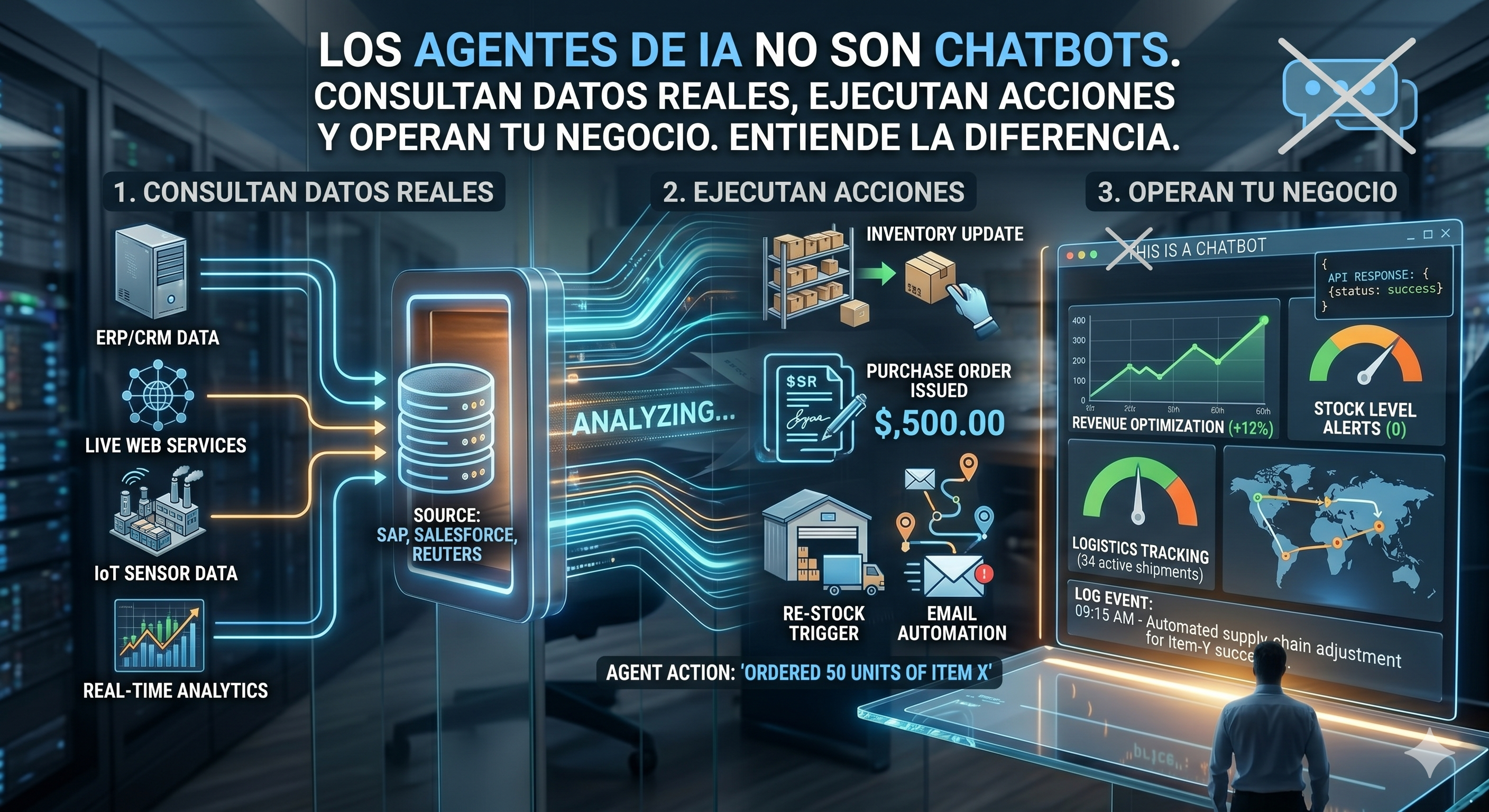
If you ask ChatGPT how many units you have in stock, it will make up a number. Not because it's bad, but because it has no access to your system. It's a language model that generates text based on patterns — it doesn't query data, doesn't execute actions, doesn't know anything about your business.
An AI agent is fundamentally different. It has access to your systems, knows how to query your database, can execute actions like creating a quote or recording a payment, and responds with real data instead of guesses. The difference is not one of degree — it's one of category.
Chatbot vs Copilot vs Agent: three very different things
There's a lot of confusion around these terms because AI marketing uses them interchangeably. But for a company looking to implement AI in its operations, the difference is critical.
A chatbot is a system that answers questions based on pre-trained text or a set of documents. It can be useful for basic customer service (hours, locations, FAQs), but it has no access to real-time data and cannot execute actions. If you ask "how much does client X owe us?", it can't answer because it doesn't see your billing system.
A copilot is an assistant that helps you do your work faster. GitHub Copilot suggests code. Microsoft Copilot helps you write emails. But you're still the one executing — the copilot only suggests. It doesn't make decisions, it doesn't operate autonomously.
An agent is a system with goals, tools, and the autonomy to execute. When you tell it "check which clients haven't paid in over 60 days and send them a reminder," the agent queries your database, identifies overdue clients, generates the appropriate message for each one, and sends it. It doesn't suggest you do it — it does it.
The key difference lies in tools. An agent has access to specific functions that let it interact with real systems: querying a database, calling an API, sending a message, creating a record. Without tools, it's just an eloquent chatbot.
How an AI agent works inside
An agent's architecture is conceptually simple:
Language model — the brain that understands what you're asking and decides what to do. It can be any model: Qwen, Llama, Claude, GPT. What matters is that it's capable enough to reason about the task.
Tools — specific functions the agent can invoke. For example: search_client(name), check_inventory(product), create_quote(client, products, prices), record_payment(invoice, amount, date). Each tool does one concrete thing and returns real data from the system.
Business context — instructions that tell the agent how to behave. What discount policies apply, how to calculate tax, what the approval process is for purchase orders above a certain amount. It's the business knowledge that a new employee takes weeks to learn.
Communication channel — how you interact with the agent. It can be a web dashboard, an in-app chat, or — and this is where it gets interesting — WhatsApp or Telegram. If your sales team already lives on WhatsApp, the agent lives there too.
When you write to the agent "give me the overdue balance for client López Distribution," the language model understands the intent, invokes the tool check_balance(client="López Distribution"), receives real data from your billing system, and presents it in readable form. No making things up. No hallucinating. Every number comes from your database.
Why enterprise chatbots fail
Most "AI chatbots" sold today are language models with a nice prompt and access to some documents. They work well for the first 10 generic questions and then start failing spectacularly:
They make up data. You ask for a product price and get a number that sounds reasonable but is completely false. In a business context, this is unacceptable — a quote with made-up prices can cost you a client or create a legal problem.
They don't execute actions. They can tell you "you should follow up with client X" but they can't create the task, send the email, or update the CRM. You still need someone to do the real work.
They don't understand your business. They know a lot about everything but nothing about your specific company. They don't know your discount policies, your pricing structure, your credit rules, or your approval workflows.
They disconnect from reality. Since they have no access to real-time data, their answers become less relevant over time. Inventory changes, prices update, clients pay or stop paying — the chatbot doesn't know.
An agent solves all these problems because it's connected to your real system. It doesn't invent data because it queries it. It executes actions because it has tools to do so. It understands your business because it has the rules configured. And it's always up to date because it queries real-time data.
Specialized agents vs a generic agent
A common mistake is thinking you need a single super-intelligent agent that does everything. In practice, it's much more effective to have specialized agents, each expert in its domain.
A sales agent knows the product catalog, can check prices and stock in real time, generates quotes, manages the opportunity pipeline, and detects inactive clients. It doesn't need to know anything about accounting.
A collections agent knows each client's account status, generates aging reports at 30, 60, 90, and 120+ days, records payments, and sends reminders. It doesn't need to know anything about inventory.
A purchasing agent controls inventory, detects products below reorder point, suggests which supplier to buy from based on price history, creates purchase orders, and tracks lots with expiration dates. It doesn't need to know anything about sales.
Specialization matters because it drastically reduces the probability of error. An agent that only handles collections has a limited set of tools and rules — it can't confuse an invoice with a quote because it doesn't have access to quotes.
Open models vs expensive APIs
Another myth is that you need a monthly subscription to OpenAI or Anthropic to have AI agents. Open-source language models (Qwen, Llama, Mistral) have reached a quality level that makes them perfectly viable for structured business tasks.
A sales agent doesn't need to write poetry — it needs to understand "give me the price for product X," invoke the right tool, and present the result. For that, a 9-billion-parameter model is more than enough.
The advantages of open models are clear: your data is never sent to public AI services like ChatGPT or Gemini, you don't depend on a single provider's availability or pricing, and you can configure automatic fallbacks between models to guarantee uptime.
What your company needs to implement agents
You don't need to replace your current systems. An agent connects to what you already have — if your inventory is in PostgreSQL, the agent queries PostgreSQL. If your data is in MySQL, it queries MySQL. If you have a REST API, it consumes it. The agent is an intelligence layer on top of your existing infrastructure, not a replacement.
What you do need is to clearly define what tools each agent will have, what business rules it must follow, and through which channels it will operate. This is more a process exercise than a technology one — if you can't explain how your sales process works to a new employee, you can't explain it to an agent either.
The Manager: AI agents for daily operations
At Leeuwwolk we developed The Manager, a business management system (CRM + ERP + Billing) that operates with three specialized AI agents: a Sales Agent, a Collections Agent, and a Purchasing Agent.
Each agent queries real system data, executes concrete actions, and is available via WhatsApp, Telegram, or web dashboard. They are not chatbots — they are operators that understand your business and work with your data.
Built with open-source language models. Leeuwwolk guarantees the privacy of your data: encryption in transit and at rest, no sharing with third parties, no sending to public AI services.
→ Learn about The Manager and its AI agents
Leeuwwolk is a Mexican company specializing in private artificial intelligence and business solutions. We guarantee your information's privacy: encryption in transit and at rest, no data shared with third parties or sent to public AI services.