Medical Transcription with AI: From Consultation to Automatic Clinical Note
An average physician spends between 30% and 50% of their workday on clinical documentation. Each consultation requires recording the interview, examination, diagnosis, treatment, and plan — all in a format that complies with NOM-004.
AI medical transcription changes this dynamic: the physician speaks with the patient normally, and the system generates a structured clinical note automatically.
How it works
The workflow has three stages.
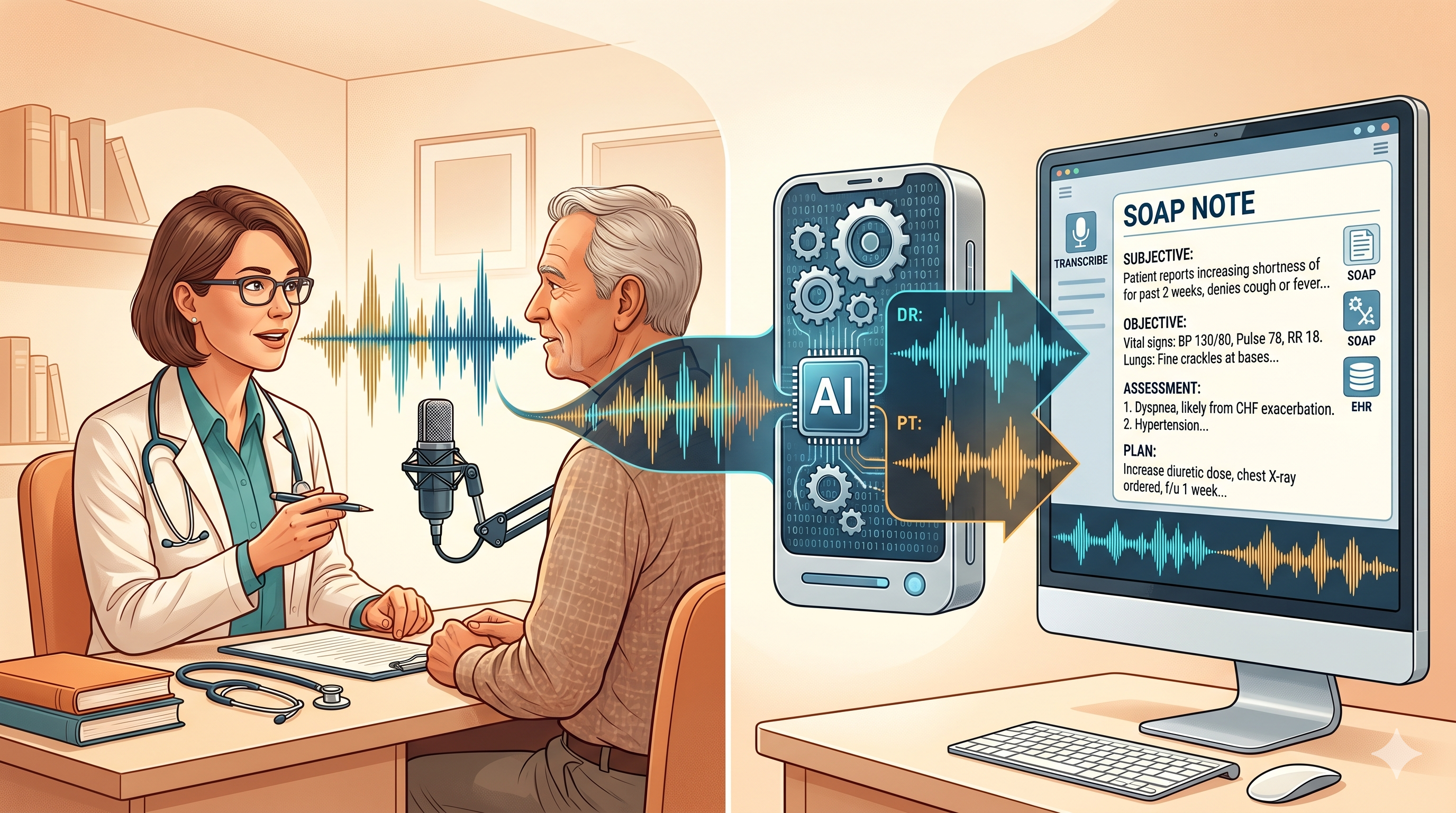
Audio capture: during the consultation, a microphone (it can be the office's or a dedicated device) records the conversation. The physician doesn't need to speak in any special way or dictate — the conversation is natural.
Transcription with diarization: AI transcribes the audio to text, identifying and separating who speaks at each moment. The physician's interventions are distinguished from the patient's. If a companion or nurse is present, they are separated as well.
Structuring into a clinical note: a language model takes the speaker-separated transcription and generates a structured clinical note. The most common format is SOAP (Subjective, Objective, Assessment, Plan), where what the patient reports goes under Subjective, examination findings under Objective, diagnostic reasoning under Assessment, and instructions under Plan.
What the physician gets
At the end of the consultation, the physician reviews a pre-structured clinical note with the key data already captured. They don't start from scratch — they start from a draft that only needs validation and, if necessary, adjustments.
Documentation time per consultation drops from 10-15 minutes to 2-3 minutes of review.
Where the data is processed
This is a critical point. Medical information is among the most sensitive data in existence. Sending medical consultation recordings to external APIs — where they are processed on third-party servers in another country — raises privacy, regulatory, and ethical concerns.
The alternative is local processing: the transcription model and language model run on a server within the clinic or hospital. The audio and transcription never leave the local network. This not only complies with data protection regulations but also builds trust with patients.
NOM-004 compliance
The AI-generated note complies with the structure required by NOM-004 for progress notes: date, time, reported vital signs, interview summary, examination findings, diagnoses, prescribed treatment, and follow-up plan.
The physician electronically signs the validated note, creating an auditable record that complies with both NOM-004 and NOM-024.
Scriba (transcription) + Medicus (clinical records) by Leeuwwolk: from consultation to structured clinical note, all on your server.