Transcription with Diarization: What It Is and Why It Matters for Records and Minutes
Transcribing audio to text is no longer new. Any phone does it reasonably well. But there is an enormous difference between "converting audio to text" and "knowing who said what in a meeting with 8 people."
For legal documents — assembly minutes, board minutes, attestations, depositions — having the text isn't enough. You need to know who said it. If one shareholder voted in favor and another against, the minutes must reflect it correctly. If the assembly chairman declared quorum and the secretary certified it, both attributions must be accurate.
That is exactly what diarization does.
What diarization is
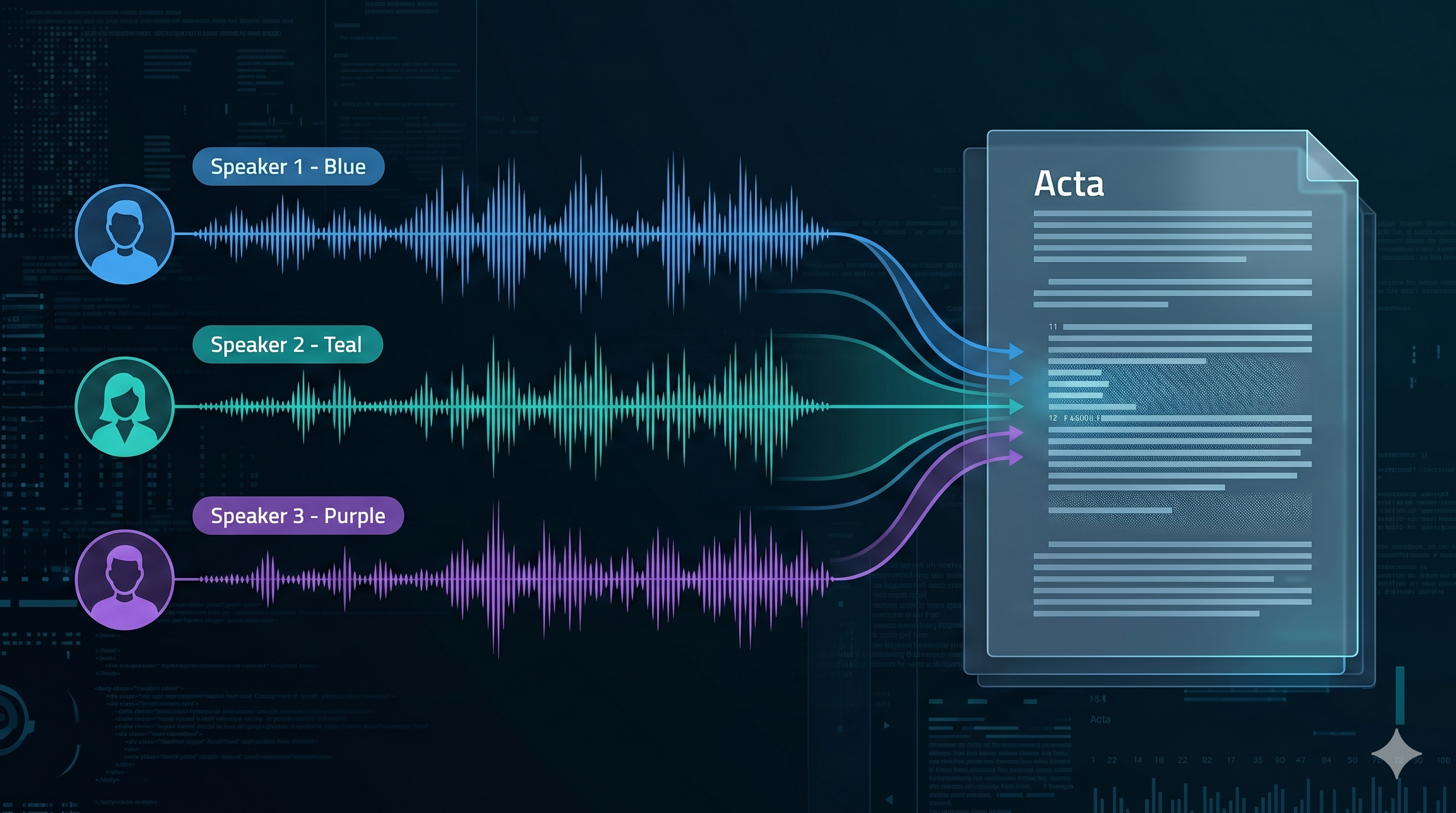
Diarization (speaker diarization) is the process of segmenting an audio recording to identify who speaks at each moment. The result is not just transcribed text but a structured conversation with each intervention attributed to a specific speaker.
Without diarization: "Good afternoon, we begin the assembly. I propose we approve the agenda as circulated. I second the motion."
With diarization: SPEAKER 1 (00:00:15): "Good afternoon, we begin the assembly." SPEAKER 2 (00:00:28): "I propose we approve the agenda as circulated." SPEAKER 3 (00:00:35): "I second the motion."
The difference seems subtle in this example. In a 2-hour assembly with 8 participants discussing approvals, objections, and conditions, it is the difference between a valid legal document and a useless one.
How it works technically
Modern diarization combines several audio processing models:
Voice Activity Detection (VAD). Identifies segments of the audio where someone is speaking, separating them from silence, background noise, and music.
Voice embedding extraction. For each speech segment, a numerical representation (embedding) is generated that captures the unique characteristics of the voice: pitch, timbre, speed, intonation patterns.
Clustering. Embeddings are grouped by similarity. Segments with similar voices are assigned to the same speaker. The system doesn't need to know the voices beforehand — it learns them from the recording itself.
Alignment with transcription. Each speaker's segments are aligned with the transcribed text, generating the final attribution: who said what and when.
The result is a transcription where each text fragment is labeled with the speaker who said it and the exact timestamp in the original recording.
Dictation vs transcription vs diarization
These three terms are frequently confused, but they are very different things:
Dictation. One person speaks deliberately for a system to write what they say. It is unidirectional (single voice), intentional (the speaker adapts their pace and pronunciation), and doesn't require identifying who is speaking because there is only one speaker. It's what Siri does when you dictate a message.
Transcription. A system converts audio to text regardless of the speaker's intention. It can handle natural conversations, multiple voices, interruptions, and spontaneous speech. It is harder than dictation because the audio is not optimized for recognition.
Transcription with diarization. Transcription that also identifies who speaks at each moment. It is the most complex level and the only one suitable for generating legal documents where attribution matters.
For assembly minutes, board minutes, depositions, and any multi-participant document, you need transcription with diarization. Dictation and simple transcription are not enough.
Limitations and ideal conditions
Diarization is not perfect, and its accuracy depends on recording conditions:
It works well when: each person speaks in reasonably clear turns, the audio has acceptable quality (without excessive echo or strong background noise), speakers have reasonably distinct voices, the recording uses a central microphone or multiple microphones.
It has difficulty when: two or more people speak simultaneously for sustained periods, audio quality is very low, there are many speakers with similar voices (more than 10-12 participants), there is background music or industrial noise.
For formal sessions (assemblies, board meetings, hearings), where participants generally speak in turns and there is a moderator, diarization works very well. For informal meetings with many cross-interruptions, accuracy decreases.
A good practice is to use a reasonably quality central conference microphone and record in a space without excessive echo. Professional equipment is not needed — a $50-100 USD USB microphone makes an enormous difference.
From diarization to legal document
Transcription with diarization is the input AI needs to generate legal documents automatically. Once the system knows who said what, it can extract relevant information according to the document type:
For assembly minutes: it identifies the chairman (SPEAKER 1), extracts the quorum declaration, agenda items, proposals with who made them, votes with breakdown, and resolutions adopted.
For meeting minutes: it identifies participants, topics discussed, agreements, responsible parties, and commitment dates.
For a deposition: it identifies the deponent and extracts the sequence of statements in chronological order.
The AI does not invent content — it extracts and structures what is in the transcription. If something was not said in the meeting, it does not appear in the document.
Scriba: transcription with diarization + document generation
At Leeuwwolk we developed Scriba to automate the entire flow: upload the audio, get the transcription with diarization, review and adjust speaker identification, and generate the legal document in your custom template. The final document is sealed on blockchain via SureSeal.
Leeuwwolk guarantees the privacy of your recordings: encryption in transit and at rest, without sharing data with third parties, without sending audio to public AI services.
→ Learn about Scriba and automate your minutes and records
Leeuwwolk is a Mexican company specializing in AI transcription and automated legal document generation.