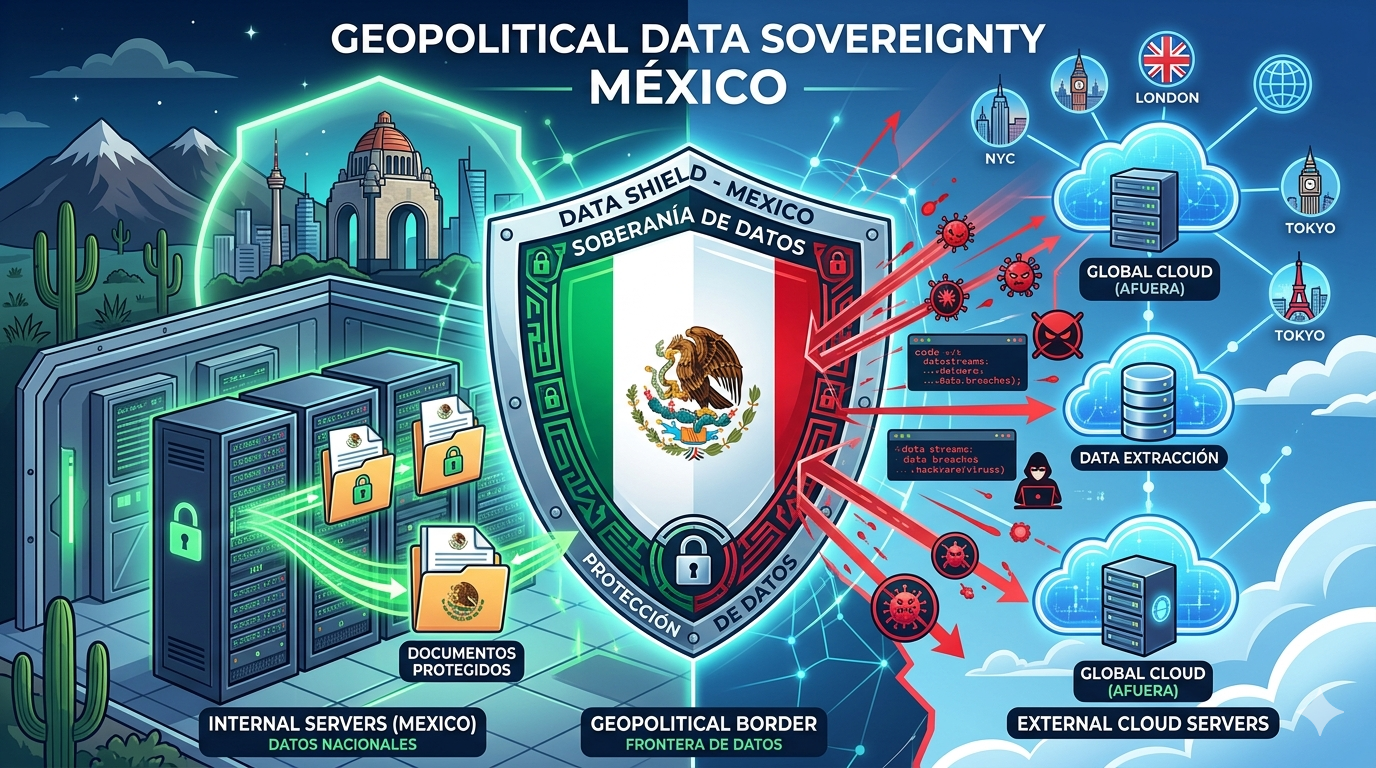
Data Sovereignty in AI: Why It Matters Where Your Documents Are Processed
When a law firm uploads a contract to ChatGPT for analysis, that contract travels to an OpenAI server in the United States. When a hospital uses a cloud AI service to transcribe consultations, the patient's audio leaves Mexico. When a company uploads its financial statements to an AI tool for analysis, that data ends up on a third party's infrastructure.
In each case, the company lost control over where its data is, who can access it, and under which legal jurisdiction it falls.
This is not paranoia. It is a basic risk analysis that any company with sensitive data should perform before integrating AI tools into its processes.
What data sovereignty is
Data sovereignty is the principle that an organization should maintain control over where its data is stored and processed, under which legal jurisdiction it falls, and who has access to it.
In the context of AI, data sovereignty becomes particularly relevant because cloud AI services require you to send your data to the provider for processing. Unlike a storage service (where data is stored but not "read"), an AI service necessarily processes — reads, analyzes, interprets — the content of your data.
When you send a document to an AI API, you are trusting that the provider will not store the content beyond processing, will not use the content to train its models, will not provide access to the content to third parties, and will comply with data protection regulations in your jurisdiction.
Each of these premises depends on the provider's policies, which can change, and on the jurisdiction where their servers operate, which you did not choose.
The jurisdictional problem
Most cloud AI providers operate from the United States. This means your data, while being processed, is subject to American legislation.
In the United States, laws like the CLOUD Act (Clarifying Lawful Overseas Use of Data Act) allow federal authorities to request access to data stored by American companies, even if that data is on servers outside the United States. This applies to Microsoft, Google, Amazon, OpenAI, and any US-incorporated company.
For a Mexican company sending client data to an American AI service, this means American authorities could theoretically request access to that data, regardless of what Mexican data protection legislation says.
In practice, this rarely happens for ordinary commercial data. But for regulated sectors — financial, healthcare, government — the mere fact that the possibility exists can be a regulatory violation.
Data Protection Law in Mexico
The Federal Law for the Protection of Personal Data Held by Private Parties (LFPDPPP) establishes specific obligations for anyone processing personal data:
Consent. The data subject must consent to the processing. If a hospital sends clinical data to an AI API without the patient knowing, there is a consent issue.
Purpose. Data must only be used for the purposes disclosed to the data subject. If the AI API uses data to train models (as some providers do with free-tier data), it is an unconsented use.
Transfer. The transfer of personal data to third parties requires consent and information to the data subject about the destination and purpose. Sending data to an OpenAI server is a transfer to a third party in another jurisdiction.
Sensitive data. Health, financial, and other data classified as sensitive have additional protection requirements. Their processing on third-party servers without express consent is particularly risky.
Sectors where sovereignty is critical
Healthcare. Clinical data is sensitive personal data by definition. The clinical record, consultation notes, diagnoses, and prescriptions are protected by the LFPDPPP and by NOM-004-SSA3-2012. Sending them to a cloud AI API to generate SOAP notes or code diagnoses is a legal risk many clinics take without evaluating.
Legal. Law firms have a confidentiality obligation to their clients. Contracts, articles of incorporation, due diligence packages, and privileged communications uploaded to AI tools pass through third-party servers. If the client finds out, the trust relationship deteriorates.
Financial. Financial institutions regulated by the CNBV have specific obligations regarding data handling. Outsourcing data processing to unregulated providers may require prior authorization and compliance with specific requirements.
Government. Government agencies processing citizen data have additional obligations under the General Law for the Protection of Personal Data Held by Obligated Parties. Processing on foreign servers is particularly problematic.
The alternative: private processing
Private AI processing means that language models, OCR models, and any other AI component run on infrastructure controlled by your organization. Data is not sent to public AI services. There is no third-party transfer. No jurisdictional risk. No dependence on privacy policies that can change.
Technically, this is possible thanks to open-source models (Qwen, Llama, Mistral) that can be downloaded and run on local hardware. The quality of these models for structured enterprise tasks is comparable to commercial models.
The cost is a hardware investment (a server with GPU) that pays for itself in months against the cost of commercial APIs. The benefit is total control over your data.
It's not all or nothing
Data sovereignty doesn't mean disconnecting from the internet. It means making conscious decisions about what data is processed where.
A reasonable strategy is: sensitive data (clinical, legal, financial, personal) is processed locally. Generic data (translations of public texts, marketing content writing, general research) can be processed in the cloud without risk.
What matters is that the decision is conscious and informed, not that an employee uploads a confidential contract to ChatGPT because it's "easier."
Leeuwwolk products: sovereignty by design
At Leeuwwolk, privacy is not a feature — it's the architecture. All our products are designed to process data locally:
Fullkro processes legal and corporate documents without sending files to external APIs. OCR and language models run on the client's server.
Medicus generates clinical notes and codes diagnoses with private AI. Consultation audio and patient data never reach public AI services.
Scriba transcribes and generates legal documents locally. The assembly recording stays on your infrastructure.
The Manager operates its AI agents with open-source language models. Your company's commercial data is processed internally.
SureSeal verifies documents without uploading them to the server. The digital fingerprint is calculated in the user's browser.
→ Learn about our private AI solutions
Leeuwwolk is a Mexican company that develops artificial intelligence solutions with private processing. Your data is yours — we just build the tools.