Agent Orchestration: How to Coordinate Multiple Specialized AIs in Your Business
The first generation of enterprise AI promised "one assistant that does everything." Reality proved that an agent trying to handle sales, purchasing, inventory, collections, and invoicing at the same time ends up doing everything poorly.
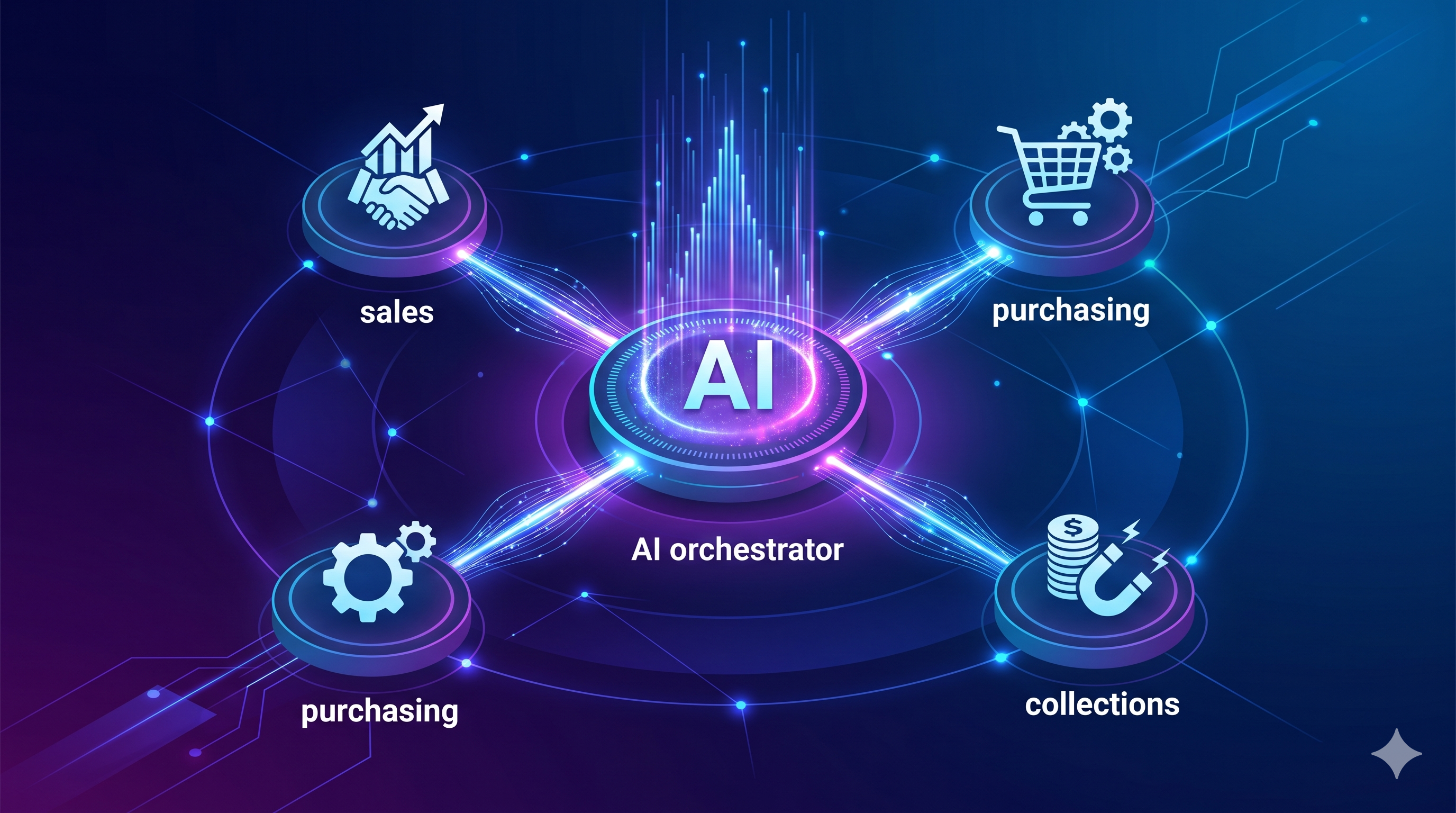
The second generation — the one emerging now — works differently. Instead of a generalist agent, it uses multiple specialized agents that coordinate with each other. Each one masters its area, has its own tools and business rules, and knows when to hand off to the right agent.
This is called agent orchestration, and it is the architecture that makes operational AI viable in real businesses.
Why a single agent doesn't work
An AI agent has a context: the instructions that tell it how to behave, the tools it can use, and the business rules it must follow. The broader that context, the more likely the agent is to get confused.
If a single agent handles sales and purchasing simultaneously, it has access to quoting tools and purchase order tools. When the user says "make me an order for 100 units of product X," the agent must decide: is it a purchase order to the supplier or a sales order from the client? With sufficient context it may get it right, but ambiguity creates errors.
If it also handles collections, confusions multiply. "How much does López owe?" could refer to how much López owes us (accounts receivable) or how much we owe López (accounts payable, if López is a supplier). A generalist agent handling both domains can confuse them.
Specialization eliminates this ambiguity. The Collections Agent only sees accounts receivable. The Purchasing Agent only sees accounts payable. There is no possible confusion because each one only has tools from its domain.
How orchestration works
Orchestration is the mechanism that coordinates specialized agents. It works like this:
Routing. When a user message arrives, a classification system determines which agent it should go to. "How many units do we have?" → Purchasing Agent (inventory). "Make me a quote for client López" → Sales Agent. "Who owes us more than 90 days?" → Collections Agent.
Specialized execution. The assigned agent processes the request with its specific tools. It only has access to its domain operations, which eliminates confusion and reduces errors.
Transfer between agents. When a request involves more than one domain, agents can pass context to each other. "Quote 100 units of product X and verify we have stock" → the Sales Agent generates the quote and consults the Purchasing Agent about available stock.
Unified channel. For the user, the experience is transparent. They write to a single WhatsApp number or use a single chat. Routing and coordination happen behind the scenes.
Specialized agents in practice
In a typical commercial environment, three agents cover 90% of daily operations:
Sales Agent. Domain: clients, catalog, prices, quotes, pipeline, follow-up. Tools: search client, query price, verify stock, create quote, update opportunity, list inactive clients. Rules: applies discounts per policy, doesn't quote out-of-stock products, follows up on quotes without response after 3 days.
Collections Agent. Domain: invoices, payments, overdue receivables, account statements. Tools: query receivables by client, generate aging report, record payment, send reminder, calculate total receivables. Rules: classifies receivables in 30/60/90/120+ day buckets, prioritizes collection by amount and age, escalates accounts above a certain amount.
Purchasing Agent. Domain: inventory, suppliers, purchase orders, receiving. Tools: query stock by warehouse, detect products below minimum, create purchase order, record receipt, verify duplicate invoice. Rules: suggests supplier by price and fulfillment history, alerts when a product is below reorder point, controls lots with expiration dates.
Each agent is an expert in its area. It doesn't try to do what doesn't correspond to it. If a user asks the Sales Agent about overdue receivables, the system redirects the query to the Collections Agent.
The vision: agents that talk to any system
Today, specialized agents operate on their own integrated system (CRM + ERP + Billing). Each agent queries and operates the same database with tools designed for it.
The future vision is that these agents can connect to the client's existing systems. If a company already has its inventory in an ERP, its client directory in a CRM, and its billing in a separate system, agents could talk to each system through their APIs or databases.
This doesn't require migration — it requires building the tools that connect each agent to each data source. The intelligence is in the agent; the data stays where it already is.
The configurable tools architecture makes this technically possible. Each tool is a function the agent invokes that internally can talk to PostgreSQL, MySQL, a REST API, or any other source. Changing the data source doesn't change the agent — only the tool implementation changes.
Intelligent coordination
Orchestration isn't just routing messages. Agents can coordinate for tasks that cross domains:
"Identify the 10 clients who bought the most last quarter and verify which ones have overdue receivables" → the Sales Agent identifies the top 10 by purchase volume, and the Collections Agent cross-references each against overdue receivables. The result is an actionable list: important clients that need to be collected from tactfully.
"What products should I restock this week?" → the Purchasing Agent detects products below minimum and the Sales Agent cross-references against open quotes to prioritize products with confirmed demand.
This coordination generates operational intelligence that today requires someone to manually cross-reference data between different modules or systems.
The Manager: three orchestrated agents
At Leeuwwolk, The Manager implements this architecture with three specialized agents that operate on an integrated business management system. Routing is automatic, coordination is transparent, and everything is accessible via WhatsApp, Telegram, or web dashboard.
Each agent queries real system data. There are no hallucinations, no invented data. And everything runs on open-source language models, with Leeuwwolk's privacy guarantee.
→ Learn about The Manager and its specialized agents
Leeuwwolk is a Mexican company specializing in enterprise AI agents and intelligent system orchestration.