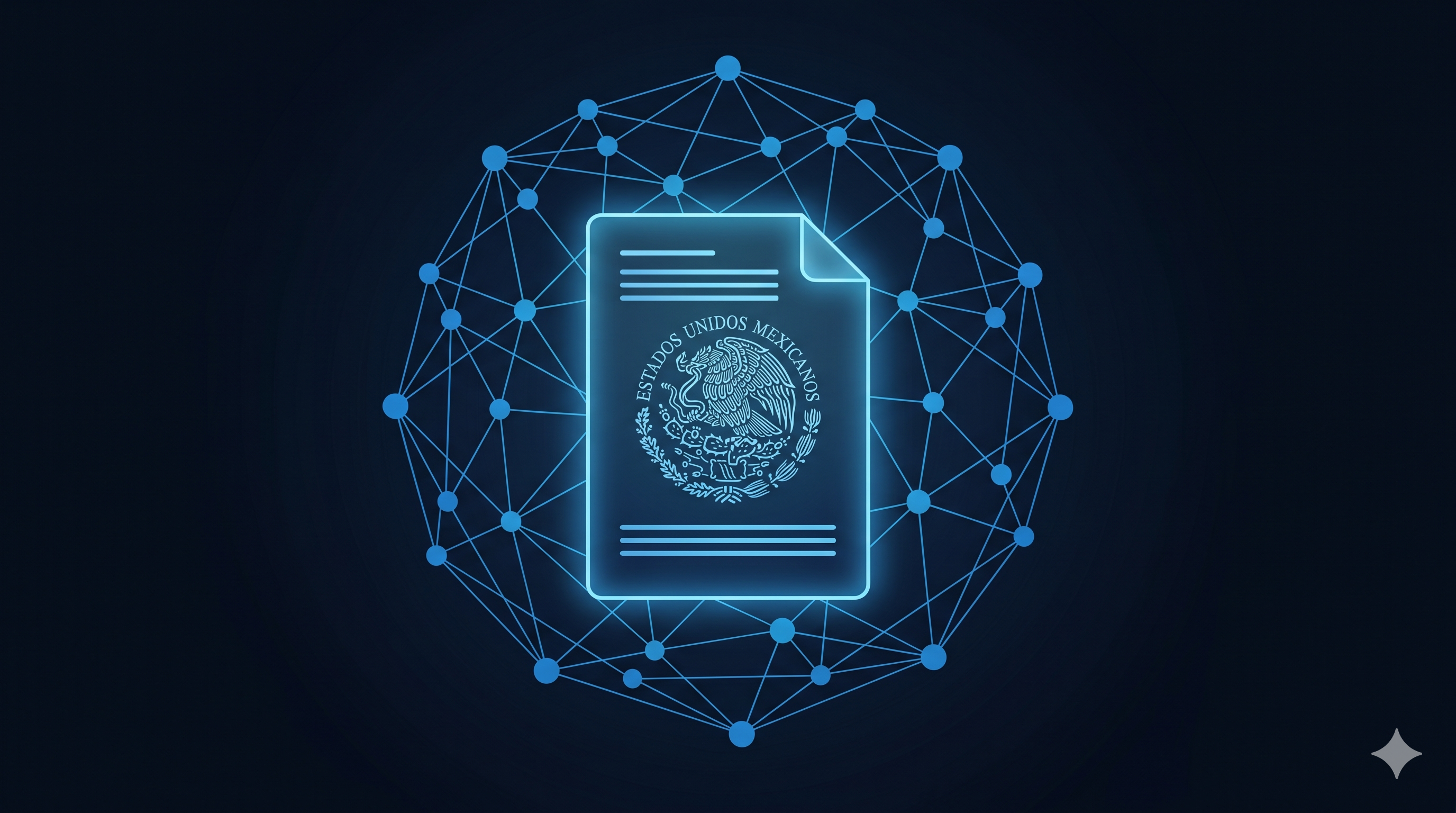
NOM-151: What It Is, What It's For, and When You Need a Certificate
If you've researched electronic signatures or digital document conservation in Mexico, you've probably come across NOM-151. It's mentioned often, understood rarely, and most available explanations are written in legal jargon that doesn't help make practical decisions.
In this article we explain in plain language what NOM-151-SCFI-2016 establishes, what a Certification Service Provider (PSC) is, when you need a NOM-151 certificate, and when you can achieve the same objective with public blockchain at a fraction of the cost.
What NOM-151 establishes
The Official Mexican Standard NOM-151-SCFI-2016 establishes the requirements for the conservation of data messages and the digitization of documents. In simple terms: it defines the rules for a digital document to have the same legal validity as its paper equivalent.
The standard applies when you need to demonstrate that a digital document has not been altered since its creation, that it was created on a specific date, and that its content is intact. These three elements — integrity, authenticity, and date certainty — are the pillars of data message conservation.
What a PSC is and what it does
A Certification Service Provider (PSC) is an entity accredited by Mexico's Ministry of Economy to issue data message conservation certificates under NOM-151.
When a PSC issues a certificate, it is certifying that at a specific moment it received a digital document (or its digital fingerprint) and can attest to its existence and integrity on that date. It is the digital equivalent of a notary attesting to a document — with the difference that the PSC operates under a specific regulatory framework for electronic documents.
The PSC certificate includes a cryptographic timestamp that links the document to a specific date and time, and is backed by the PSC's infrastructure and its accreditation with the Ministry of Economy.
When you need a NOM-151 certificate
Not always. The NOM-151 certificate is the highest level of protection for digital documents in Mexico, but it is also the most expensive. Using it for every email or every progress photo would be like going to the notary for every taxi receipt.
A NOM-151 certificate makes sense when the document in question has significant economic or legal value and there is a reasonable probability it will be challenged in litigation or an audit.
Examples where it does make sense: the principal contract of a high-value transaction, the complete evidence package of a fiscal materiality file, a modification agreement that changes the terms of an important business relationship, or documents that by specific regulation require certified conservation.
When blockchain is enough
Article 350 of the National Code of Civil and Family Procedures establishes that information registered on public blockchain constitutes full proof. This means a document whose digital fingerprint is registered on a public blockchain has evidentiary weight equivalent to a notarial instrument.
For most supporting documents in a materiality file — progress photos, emails, meeting minutes, work logs, screenshots — blockchain sealing is more than enough. They have verifiable date certainty, verifiable integrity, and the evidentiary weight of Art. 350.
The practical difference between blockchain and NOM-151 is that the PSC certificate adds an additional layer of institutional certification. In litigation, the judge can verify that the certificate was issued by an accredited PSC, which may carry additional weight depending on the case context.
But for 80% of the documents in a file, public blockchain is sufficient and costs a fraction.
The tiered strategy
The smart way to protect a complete file is to use different levels of protection based on the importance of each document:
Tier 1 — Blockchain only. For supporting documents: photos, emails, minutes, logs, screenshots, internal reports. Date certainty and full proof under Art. 350 CNPCF. Minimal cost.
Tier 2 — e.firma + blockchain. For documents requiring consent: contracts, deliverable acceptances, purchase orders, modification agreements. The SAT e.firma links the signer to their RFC. Moderate cost.
Tier 3 — e.firma + blockchain + NOM-151. For critical documents: principal contract, final file package, high-value transactions. Total protection with institutional certification. Higher cost but justified by the document's importance.
From a typical file with 14 document types, perhaps only 2 need Tier 3. About 6 carry Tier 2. And the other 6 go with Tier 1. This dramatically reduces cost without sacrificing legal security.
Difference between NOM-151 and electronic signature
A common mistake is confusing NOM-151 with electronic signatures. They are complementary but different.
The electronic signature (SAT e.firma) certifies who signed the document and links the signer to their RFC. It is the digital equivalent of a handwritten signature. Its legal basis is in the Commercial Code, articles 89 to 114.
The NOM-151 certificate certifies that the document existed on a specific date with specific content. It is the digital equivalent of the public registry date stamp or notarial attestation of a document's existence.
A document can have an electronic signature without NOM-151 (someone signed it but there is no date certification). It can have NOM-151 without an electronic signature (its existence was certified but it wasn't signed). And it can have both (signed and certified with date certainty).
For a complete materiality file, critical documents ideally have both: electronic signature certifying consent and NOM-151 or blockchain certifying date certainty.
How to verify a NOM-151 certificate
Certificates issued by an accredited PSC are verifiable. Each certificate includes a unique identifier that can be checked against the PSC's infrastructure to confirm its authenticity.
For documents sealed on blockchain (with or without NOM-151), verification is even simpler: calculate the document's digital fingerprint and compare it against the record on the public blockchain. If it matches, the document is authentic and intact. If it doesn't match, it was altered.
This verification can be done without uploading the document to any server. The fingerprint is calculated in the user's browser, and only the fingerprint (not the document) is compared against the public record. The document's content remains private.
SureSeal: all three tiers on a single platform
At Leeuwwolk we developed SureSeal so companies can protect complete files using the tiered strategy: blockchain for supporting documents, e.firma + blockchain for documents with consent, and e.firma + blockchain + NOM-151 for critical documents.
Documents are grouped into projects that form complete materiality files. At the end, an evidence package is generated ready to present to the SAT, auditors, or a judge. Verification is public via QR without uploading files.
→ Learn about SureSeal and protect your documents at the right level
Leeuwwolk is a Mexican company specializing in private artificial intelligence and blockchain digital signature solutions.