Private AI vs Public AI: The Definitive Guide for Businesses in Mexico
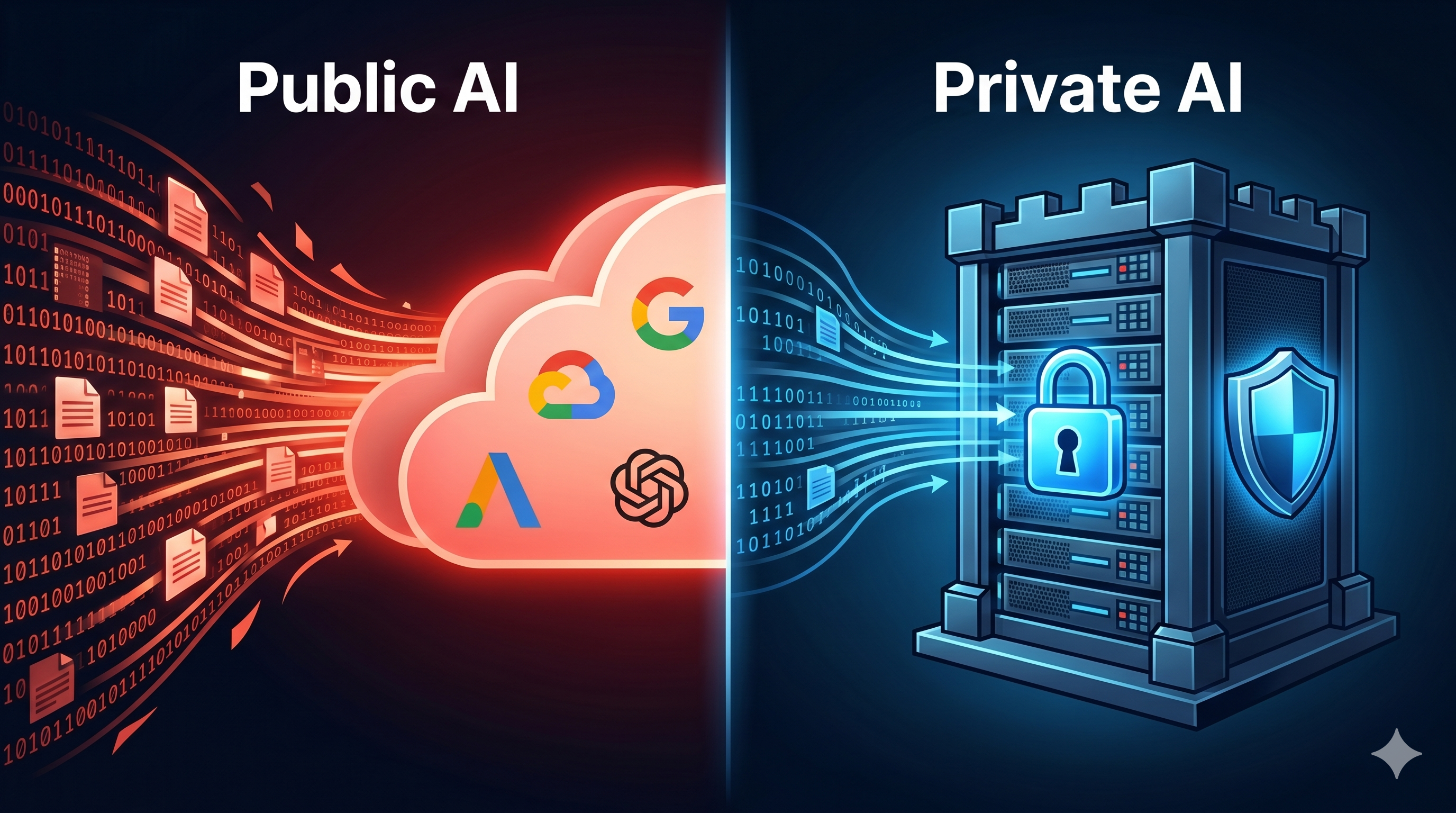
When an employee uploads a contract to ChatGPT for a summary, that contract travels to an OpenAI server in the United States. When a doctor uses a cloud AI assistant to generate clinical notes, the patient's data leaves their practice. When a financial analyst asks Gemini to review an income statement, Google processes that information on its infrastructure.
For many tasks, this is acceptable. For many others — especially in regulated sectors or with commercially sensitive information — it is not.
This article explains the real difference between public AI and private AI, when it matters, when it doesn't, and how to implement language models on your own infrastructure without depending on external APIs.
What public AI is
Public AI refers to artificial intelligence services offered by external providers where user data is processed on the provider's infrastructure. The best-known examples are ChatGPT (OpenAI), Gemini (Google), Claude (Anthropic), and Copilot (Microsoft).
When you use these services, your information travels over the internet to the provider's servers, is processed there, and the result comes back to you. The provider has technical access to your data during processing. What they do with it depends on their privacy policies, which can change, and the legal jurisdiction where their servers operate.
For personal use or generic tasks (drafting an email, translating text, researching public information), public AI works well and is convenient. The problem arises when the data you process is confidential, regulated, or commercially sensitive.
What private AI is
Private AI means artificial intelligence models run on infrastructure controlled by your organization. Data is not sent to public AI services. No third-party APIs process your confidential information.
This is possible thanks to open-source language models. Projects like Qwen (Alibaba), Llama (Meta), and Mistral have published models anyone can download and run on their own hardware. The quality of these models for structured enterprise tasks is comparable to commercial models.
A server with a dedicated GPU can run a 9-billion-parameter language model with sufficient performance for enterprise use: document data extraction, clinical note generation, contract analysis, text classification, question answering over databases.
When the difference matters
You don't always need private AI. These are the situations where it does matter:
Clinical data. Medical records, consultation notes, diagnoses, prescriptions. The General Law for the Protection of Personal Data classifies health data as sensitive. Sending it to an external API is a legal and ethical risk.
Confidential legal documents. Contracts under negotiation, articles of incorporation, beneficial owner information, due diligence packages. If your firm uploads these documents to ChatGPT, your clients' data is on OpenAI servers.
Financial information. Income statements, projections, valuations, material non-public information. For publicly traded companies, this can constitute a regulatory issue.
Sensitive commercial data. Price lists, profit margins, business strategies, client information. Your competitor doesn't need to hack your network if your employees upload everything to public services.
Regulated sectors. Financial institutions subject to CNBV regulation, companies with AML obligations, government agencies. Many regulatory frameworks explicitly prohibit processing sensitive data on uncontrolled infrastructure.
When it does NOT matter
For generic tasks not involving confidential data, public AI is perfectly valid and generally more convenient:
Drafting generic emails. Translating public texts. Generating marketing ideas. Researching general topics. Writing code. Summarizing public articles. Creating presentations with non-confidential content.
The rule is simple: if you wouldn't give that information to a stranger on the street, don't give it to a public API.
The real cost of private AI
The most common argument against private AI is cost: "we need an expensive server with costly GPUs." This was true two years ago. Today the reality is different.
A server with a GPU capable of running enterprise language models (like an NVIDIA RTX A4000 or RTX 4090) costs between $1,500 and $3,000 USD. It's a one-time investment that pays for itself in months compared to the cost of commercial API subscriptions.
The operating cost of processing documents with a local model is effectively zero after the initial investment — no per-token charges, no per-query charges, no monthly subscription. In a real benchmark with 196 legal documents, private processing had zero cost versus approximately $300 USD that a commercial API would have cost.
For companies processing high volumes of documents, private AI is not only more secure — it's cheaper.
How to implement private AI
Implementing private AI requires three components:
Hardware. A server with a dedicated GPU. It doesn't need to be enterprise — a workstation with a 16GB VRAM GPU is sufficient for most enterprise applications.
Software. Inference tools like llama.cpp or vLLM that allow running open-source language models on your hardware. They are free and open source.
Models. Downloadable language models from HuggingFace or other repositories. Qwen, Llama, and Mistral offer models of different sizes depending on your performance and accuracy needs.
Technical setup takes hours, not months. A team with Linux and GPU experience can have a private AI server operational in a day.
Leeuwwolk products: applied private AI
At Leeuwwolk, all our products operate with private AI models:
Fullkro analyzes legal and corporate documents without sending files to any external API. OCR and the language model run on the client's server.
Scriba transcribes audio and generates legal documents with private processing. Your assembly recording never reaches a public AI service.
Medicus generates clinical notes from medical consultation transcriptions. Your patients' data is processed locally.
The Manager operates with open-source language models for its AI agents. Your company's commercial data doesn't travel to third-party servers.
SureSeal seals documents on blockchain and verifies without uploading files to the server. The digital fingerprint is calculated in the browser.
→ Learn about our private AI products
Leeuwwolk is a Mexican company that develops private artificial intelligence solutions for businesses that need to maintain total control over their data.