AI in Medical Practice: How Automatic Transcription Can Give You Back 2 Hours a Day
Ask any physician what bothers them most about their job and the answer will rarely be "seeing patients." It will be paperwork. Progress notes, prescriptions, patient records, reports. Clinical documentation consumes 2 to 3 hours a day of a physician's time — time not spent seeing patients, that doesn't generate additional revenue, and that produces professional burnout.
The problem isn't that documentation is unnecessary. It is necessary, regulated by NOM-004, and protects both the patient and the physician. The problem is that the way it's generated hasn't changed in decades: the physician sees the patient, then sits down to write what they remember from each consultation.
How a physician works today
The typical flow of a consultation in a private practice in Mexico goes something like this:
The patient arrives. The physician greets them, reviews the reason for the visit, asks about symptoms, history, current medications. Examines the patient. Reaches a diagnosis or diagnostic hypothesis. Prescribes treatment. Schedules follow-up.
All of this takes 15 to 30 minutes. This is the part the physician enjoys and studied for.
Then comes documentation. The physician opens their system (or paper form) and captures: patient data, reason for visit, physical examination, diagnosis with ICD code, prescribed treatment, follow-up plan. This takes another 10 to 20 minutes per patient.
With 15 to 20 patients a day, documentation piles up. Many physicians end up documenting at the end of the day, reconstructing from memory what happened in each consultation hours earlier. Documentation quality degrades as the day progresses.
The alternative: talk to your patient, AI does the record
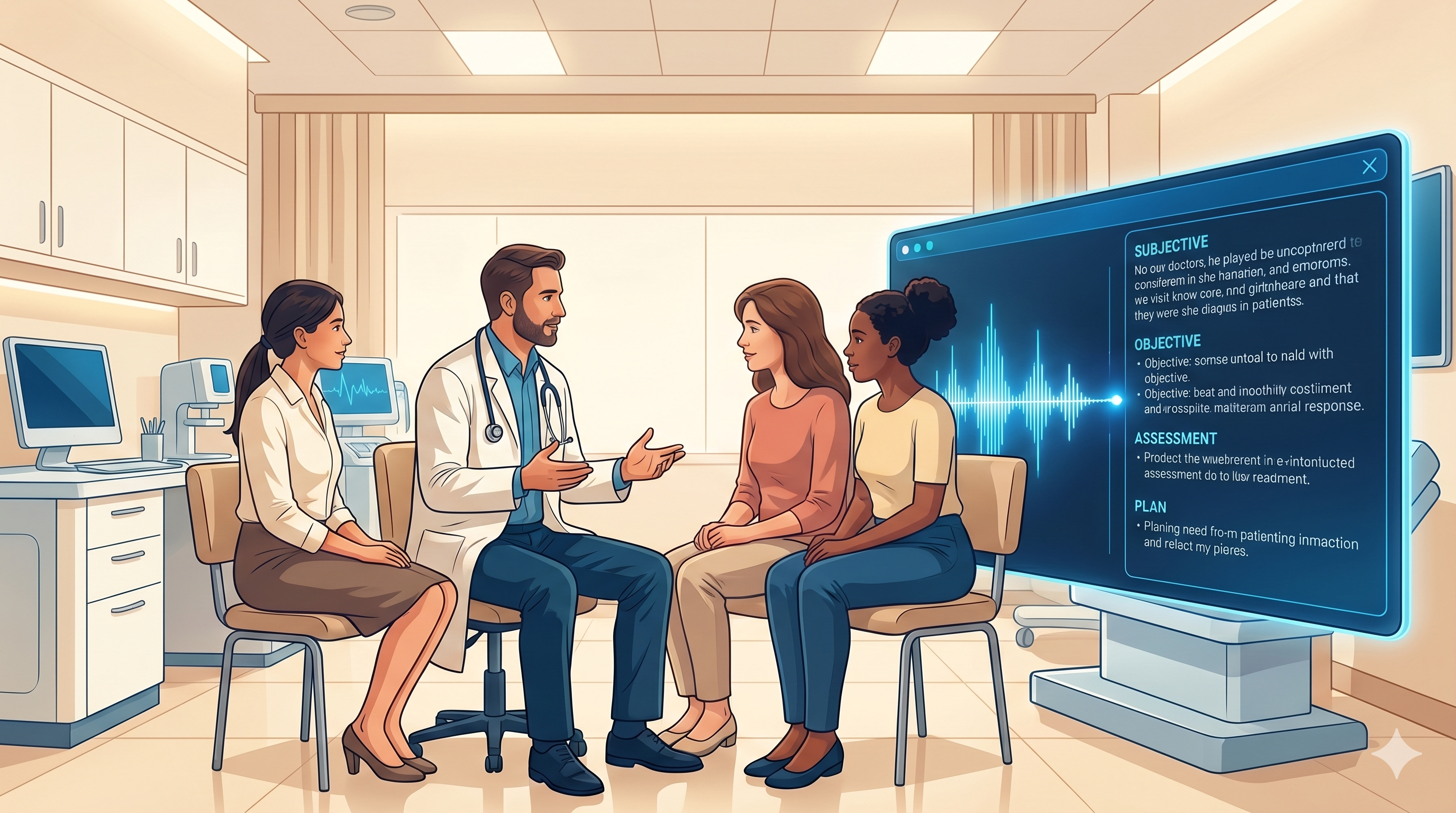
The idea is elegant in its simplicity: the physician changes absolutely nothing about their consultation. They talk to their patient as always, ask the same questions, do the same examination. The only difference is the conversation is recorded.
After the consultation, the recording goes through three automatic stages:
Transcription with diarization. The audio is converted to text, identifying who speaks (physician vs patient). It's not dictation — the system understands a natural conversation with interruptions, questions, answers, silences.
Clinical extraction. The AI analyzes the transcription and extracts relevant clinical information: reason for visit, reported symptoms, examination findings, mentioned diagnoses, prescribed medications with dosage and frequency, follow-up plan.
SOAP note generation. With the extracted information, the clinical note is generated in SOAP format (Subjective, Objective, Assessment, Plan). The physician reviews, adjusts if necessary, and approves. The note is recorded in the patient file.
Documentation time per consultation goes from 15-20 minutes to 2-3 minutes of review.
What SOAP format is and why it matters
SOAP is the international standard for clinical notes:
Subjective. What the patient reports: symptoms, complaints, duration, intensity. "Reports epigastric pain of 3 days' duration, burning type, worsening with food."
Objective. What the physician observes: vital signs, physical examination findings. "Abdomen soft, depressible, painful on palpation in epigastrium. No signs of peritoneal irritation."
Assessment. The clinical reasoning: diagnosis or differential diagnoses, ICD-11 coding. "DA92 Gastritis, unspecified."
Plan. Prescribed treatment and follow-up: medications with dosage, frequency, and duration, ordered studies, next appointment.
AI can generate this structure because the physician-patient conversation naturally follows a similar flow: the patient describes symptoms (Subjective), the physician examines (Objective), reaches a diagnosis (Assessment), and indicates treatment (Plan).
Automatic ICD-11 coding
The International Classification of Diseases (ICD-11) is the global standard for coding diagnoses. In Mexico, its use is mandatory in the clinical record.
Manual coding requires the physician to search for the correct code in a catalog of thousands of entries. It's tedious and error-prone — many physicians end up using the same 10 generic codes for everything because they don't have time to search for the specific one.
Automatic coding works like this: the AI identifies the diagnosis mentioned in the consultation ("looks like gastritis"), searches for the corresponding ICD-11 code (DA92), and suggests it to the physician. The physician confirms or selects an alternative. The process takes seconds instead of minutes.
Drug interaction alerts
When the physician prescribes a medication, the system automatically cross-references against the patient's current medications. If there is a known interaction, the system alerts before the prescription is generated.
Interactions are classified by severity: mild (monitor), moderate (consider alternative), and severe (contraindication). The database used contains information on thousands of drugs with their documented interactions.
This is especially valuable for polypharmacy patients — older adults with diabetes, hypertension, and other comorbidities taking 5 or more medications. The risk of interactions grows exponentially with the number of drugs, and no physician can memorize all possible combinations.
Privacy: why the model must be local
Clinical data is, by definition, sensitive personal data. The General Law for the Protection of Personal Data classifies it as such and establishes strict obligations for its handling.
If the transcription system sends consultation audio to a cloud AI API (OpenAI, Google, etc.), that data is traveling over the internet and being processed on servers the physician doesn't control. The patient did not consent to their medical conversation being processed on a third party's servers in another country.
The alternative is working with a provider that guarantees processing privacy. At Leeuwwolk, consultation audio and clinical data are protected with encryption in transit and at rest. We don't share data with third parties, don't use it to train models, and it never reaches public AI services like ChatGPT or Gemini.
For small practices, a server with a dedicated GPU is a one-time investment. For clinics and hospitals, it integrates into existing infrastructure.
Vs. the competition in Mexico
Electronic health record systems available in Mexico (Nimbo-X, Doctoralia Pro, Medikit, iClinic) share one characteristic: they all require manual data entry. The physician types. Some offer templates to speed up entry, others allow checkboxes instead of free text, but the documentation work remains the physician's.
No Mexican competitor offers consultation transcription with automatic clinical extraction. It's a category that simply doesn't exist in Mexico yet.
Medicus: the record that fills itself
At Leeuwwolk we developed Medicus as a complete electronic health record system with integrated AI: automatic transcription with diarization, AI-generated SOAP notes, ICD-11 coding, drug interaction alerts, prescription generation with SAT e.firma signature, appointment scheduling with WhatsApp chatbot, and multi-clinic support.
Leeuwwolk guarantees the privacy of your information: encryption in transit and at rest, without sharing data with third parties. Your patients' data never reaches public AI services like ChatGPT or Gemini.
→ Learn about Medicus and eliminate paperwork from your practice
Leeuwwolk is a Mexican company specializing in private artificial intelligence for the healthcare sector.