Electronic Signature in Mexico: e.firma SAT, Simple Signature, and Advanced Signature — What They Are and Which One You Need
"Electronic signature" is a term used in Mexico to describe very different things. From typing your name at the end of an email to using your SAT e.firma with a digital certificate. The problem is that each type of signature has different legal weight, and choosing the wrong one can leave you unprotected when you need it most.
In this article we explain the types of electronic signatures recognized by Mexican law, which has the greatest evidentiary weight, when you need each one, and how they combine with blockchain sealing to generate robust legal evidence.
What Mexican law says
The legal framework for electronic signatures in Mexico is in the Commercial Code, articles 89 to 114. These articles recognize two types:
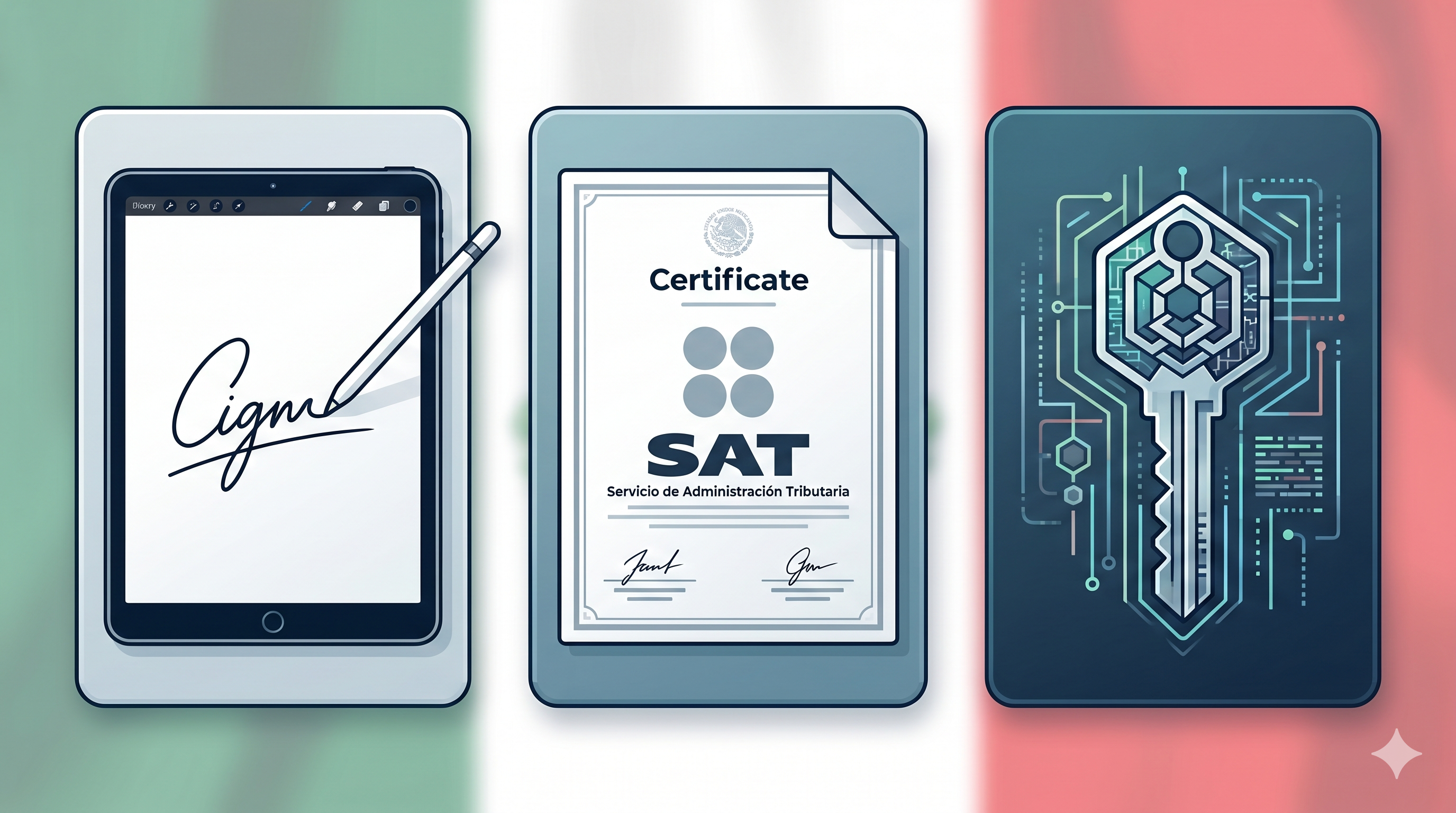
Simple electronic signature. Any data in electronic form included in a data message that can be used to identify the signer. This ranges from a name typed at the end of an email to a click on "I accept" on a web platform, to a signature drawn with a finger on a tablet.
Advanced electronic signature (FEA). An electronic signature that meets additional requirements: it is unique to the signer, is under their exclusive control, is linked to a digital certificate issued by a certifying authority, and allows detection of any modification to the document after signing.
The SAT's e.firma is the best-known example of an advanced electronic signature in Mexico. Each taxpayer has a digital certificate (.cer file) and a private key (.key file) issued by the SAT that link their identity to their RFC (tax ID).
The difference in evidentiary weight
The Commercial Code establishes that the advanced electronic signature has the same legal effects as a handwritten signature. This means a contract signed with SAT e.firma has exactly the same validity as one signed by hand before witnesses.
The simple electronic signature is also valid, but its evidentiary weight is lower. If someone challenges a document signed with a simple signature, the burden of proving the signature is authentic falls on the party presenting it. With an advanced signature, the burden is reversed: the challenger must prove that the signature does not belong to the certificate holder.
In practical terms: if you're signing an important contract, use e.firma. If someone accepts terms and conditions on a platform, a simple signature (click on "I accept" + IP and timestamp logging) may be sufficient.
The problem with generic signature platforms
Platforms like DocuSign, HelloSign, or Mifiel offer electronic signatures, but there are important nuances:
Most signatures generated by these platforms are simple electronic signatures — not advanced. The user receives an email, clicks a link, types their name or draws a signature, and the platform generates a signing certificate. This has legal value, but it is not equivalent to signing with SAT e.firma.
No foreign platform offers SAT e.firma signing because they don't have access to the SAT's infrastructure. If you need to link the signature to the taxpayer's RFC irrefutably, you need a system that integrates e.firma.
Another point: most of these platforms store signed documents on their servers (usually in the United States). For confidential documents, this can be a data sovereignty issue.
Signature + Blockchain: the strongest combination
The electronic signature certifies who signed. Blockchain certifies when it was signed and that the document has not been altered since. Together, they generate the most robust legal evidence that Mexican law allows.
When a document is signed with SAT e.firma and sealed on public blockchain, you have:
Irrefutable identity. The e.firma links the signer to their RFC. They cannot deny it — the digital certificate is unique and under their exclusive control.
Immutable date certainty. The blockchain transaction records the exact moment of sealing. No one can alter that date afterward.
Verifiable integrity. Any modification to the document after sealing generates a different digital fingerprint. Tampering is automatically detected.
Full evidentiary weight. Art. 350 of the CNPCF establishes that information on blockchain constitutes full proof. Combined with e.firma (Art. 89-114 Commercial Code), it is the highest level of digital evidentiary weight in Mexico.
When to use each type
Simple signature — For low-importance acceptances: terms and conditions, receipt confirmations, internal authorizations. Log the IP, timestamp, and user action. It's better than nothing but won't withstand strong challenges.
Simple signature + blockchain — For documents that need date certainty but don't require RFC identification: progress photos, internal minutes, logs, relevant emails. Blockchain sealing adds full proof of existence and date.
SAT e.firma — For documents where the signer's identity is critical: contracts, deliverable acceptances, purchase orders, agreements. Links the signer to their RFC irrefutably.
SAT e.firma + blockchain — For critical documents where you need both identity and date certainty: principal contracts, fiscal materiality evidence packages, documents likely to be challenged.
SAT e.firma + blockchain + NOM-151 — For maximum protection: the principal contract of a high-value transaction, the final package of a materiality file. Adds institutional certification from an accredited PSC.
SureSeal: signature and sealing in a single flow
At Leeuwwolk we developed SureSeal to combine electronic signature with SAT e.firma and blockchain sealing in a single flow. The signer uploads their .cer and .key files, signs the document, and SureSeal records the hash on blockchain automatically.
Verification is public: anyone can verify the signature and sealing by scanning a QR code. The document is never uploaded to the server — the hash is calculated in the user's browser.
For documents requiring the maximum level, SureSeal integrates NOM-151 certificate issuance through an accredited PSC.
→ Learn about SureSeal and sign with maximum legal force
Leeuwwolk is a Mexican company specializing in digital signatures and blockchain sealing for businesses.