Document Due Diligence with AI: What Can Be Automated and What Cannot
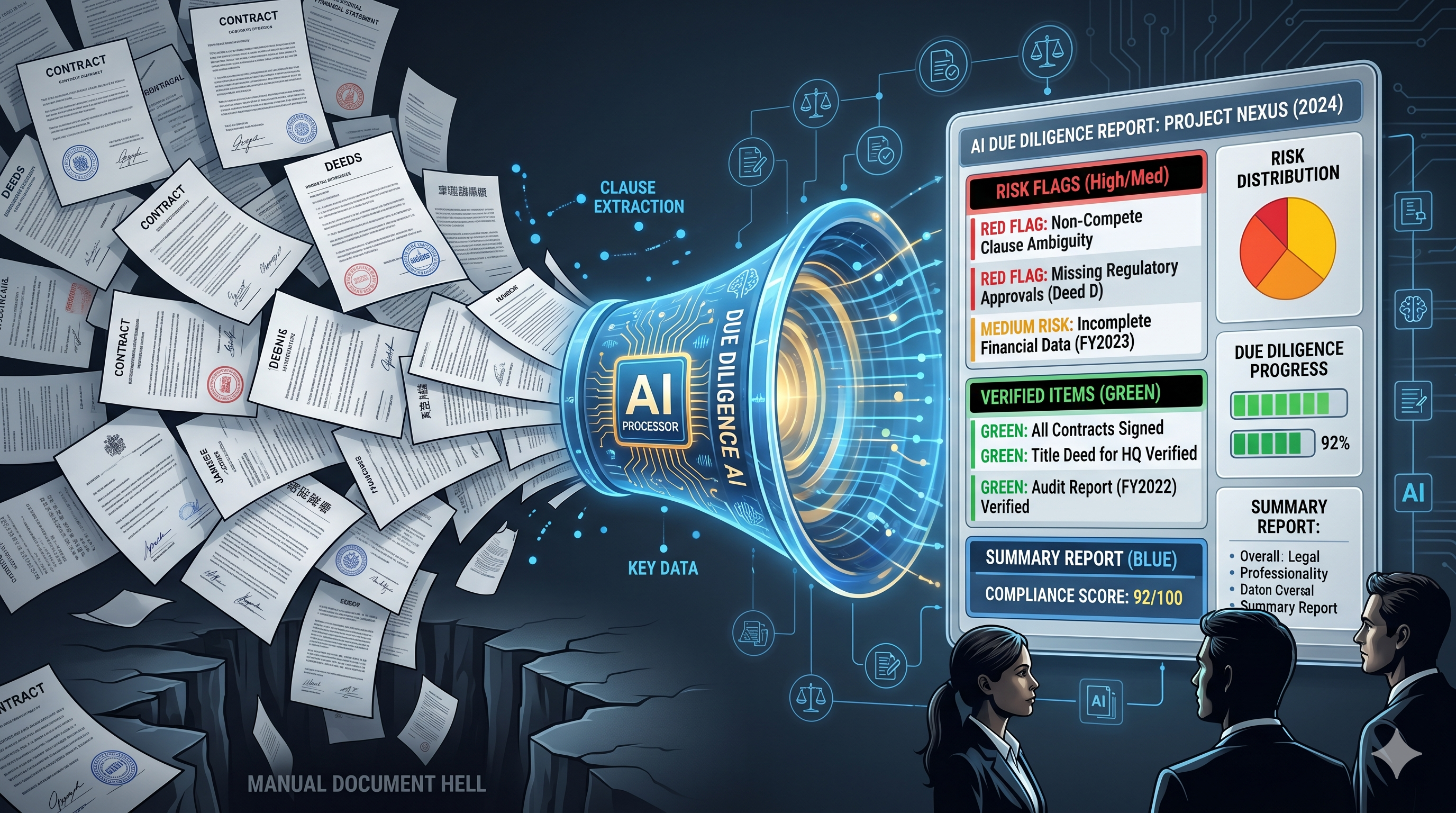
Due diligence in a corporate transaction — merger, acquisition, investment, or strategic alliance — requires reviewing hundreds of documents: articles of incorporation, commercial contracts, notarial powers of attorney, financial statements, employment contracts, licenses, and permits.
For a law firm or compliance team, this review can take weeks. The relevant question is: what part of this work can AI automate?
What it CAN automate
AI excels at repetitive, high-volume, low-ambiguity tasks.
Key data extraction: from each document, extract fields such as parties involved, dates, amounts, terms, conditions, and relevant clauses. This is mechanical, and AI performs it with high accuracy.
Document classification: identify whether a document is a contract, power of attorney, article of incorporation, financial statement, or license, and organize it in the corresponding category.
Inconsistency detection: find discrepancies between documents — a different tax ID between two contracts from the same company, a legal representative signing without valid power of attorney, an address that doesn't match across documents.
Completeness verification: against a predefined checklist, verify which documents are present and which are missing.
Executive summary: generate a summary of each document with key data, saving full reading on the first pass.
What it CANNOT automate
Legal judgment on materiality: AI can detect that a change-of-control clause exists in a contract, but it cannot assess whether that clause is a deal-breaker for the specific transaction. That requires commercial context and legal judgment.
Contextual risk assessment: a contract with a client representing 60% of the target company's revenue carries a risk that only a human with deal context can evaluate.
Condition negotiation: AI doesn't negotiate price adjustments, conditions precedent, or representations and warranties.
Jurisdictional interpretation: the legal implications of the same clause vary across jurisdictions. AI is not a lawyer and doesn't replace jurisdictional judgment.
The right model
AI doesn't replace the lawyer in due diligence. It removes the mechanical work — the hours of reading, data entry, and organization — so lawyers can focus on what only a human can do: analyze, assess risk, and make decisions.
A due diligence that previously took 3 weeks can be reduced to 1 week: AI processes the document volume in the first days, and the legal team dedicates the rest to analysis and evaluation with already-structured data.
Fullkro by Leeuwwolk processes corporate documents with fine-tuned OCR and AI extraction. Your client's documents never leave your server.