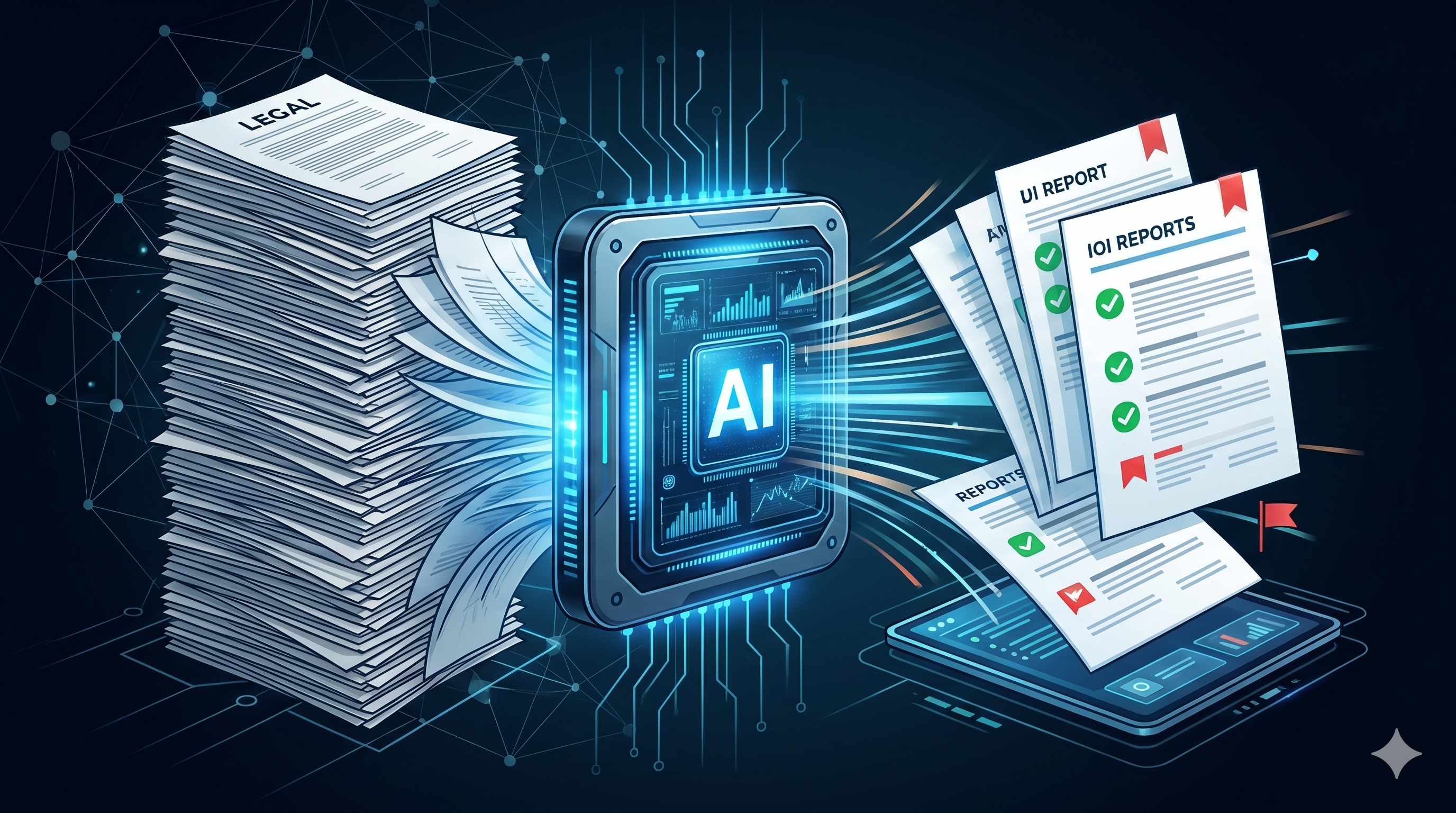
Automated Due Diligence: From Days to Minutes with Local AI Processing
Corporate due diligence is an exercise in patience. An analyst receives a package of 30 to 50 documents per entity: articles of incorporation, powers of attorney, shareholder IDs, proof of address, financial statements, commercial registry filings, tax compliance opinions. They must open each one, read, extract key data, cross-reference information between documents, detect inconsistencies, and generate a report.
With one package, it takes a day. With 10 packages in queue, it takes two weeks. And when the deal has a deadline, due diligence becomes the bottleneck that delays everything.
What gets extracted in a typical due diligence
The data an analyst looks for in each package is predictable:
From articles of incorporation: company name, entity type, incorporation date, corporate purpose, share capital, address, notary data, deed number.
From shareholder records: names of partners or shareholders, ownership percentages, nationality, ultimate beneficial owner (UBO) identification — whoever directly or indirectly controls more than 25% of the entity.
From IDs: full name, date of birth, document number, expiration date. Cross-reference against the shareholder list to verify that the people listed as partners are the same ones presenting identification.
From tax documents: tax ID or equivalent, tax address, tax regime, compliance status.
From financial statements: total assets, revenue, net income, debt, key financial ratios.
Each of these data points is manually searched in documents that can have any format, in any language, with any scan quality.
Why traditional automation doesn't work
The first reaction of many teams is "let's buy OCR software." The problem, as we explained in another article, is that template-based OCR doesn't work for variable-format documents.
Articles of incorporation from 1998 in Nuevo León look nothing like one from 2024 in Mexico City. A Mexican passport looks nothing like an American one. A SAT tax compliance certificate looks nothing like an IRS EIN confirmation letter.
Template-based OCR requires a template for each format variation. In due diligence, where you receive documents from multiple jurisdictions, notary offices, and time periods, the number of variations is unmanageable.
Contextual AI for due diligence
The solution is using language models that understand the document's content regardless of its format. The model reads articles of incorporation and understands it's reading articles of incorporation — it identifies relevant sections, extracts structured data, and returns it in a consistent format.
The complete flow for a due diligence package:
Bulk upload. The analyst uploads all documents in the package at once. No need to classify or name them in a specific way.
Automatic classification. The system identifies what type of document each file is: articles of incorporation, ID, proof of address, power of attorney, financial statement.
OCR and extraction. Scanned documents go through specialized OCR. Digital ones are processed directly. Each document is analyzed with a specialized prompt for its type.
Cross-validation. Data from different documents is automatically cross-referenced. Shareholder names in the articles are compared against presented IDs using fuzzy matching (to handle variations like "Juan Pérez" vs "Juan Manuel Pérez García"). Ownership percentages are summed to verify they total 100%. Ultimate beneficial owners exceeding the regulatory threshold are flagged.
Structured report. Extracted and validated data is presented in a consolidated view that the analyst reviews, corrects if necessary, and approves.
The privacy factor
Due diligence documents contain extremely sensitive information: personal IDs, tax data, shareholder structure, confidential financial information. These are exactly the type of documents that should not be processed on third-party servers.
If the analysis system sends these documents to a cloud API, the data of the entity under review — and of all individuals linked to it — travels over the internet and is processed on infrastructure the analyst doesn't control.
For law firms, investment funds, and financial institutions, this can be a breach of their confidentiality obligations to the client, of data protection regulations, and of anti-money laundering regulations that require controls over sensitive information handling.
Private processing completely eliminates this risk. Documents are processed on a server within the firm's or institution's network. OCR and language models run locally. No data leaves.
Ultimate beneficial owner detection
Ultimate Beneficial Owner (UBO) identification is a regulatory requirement in Mexico and most jurisdictions. Every individual who directly or indirectly owns more than 25% of the capital or exercises effective control over the entity must be identified.
In simple corporate structures, this is straightforward. In structures with multiple corporate layers, subsidiaries, and trusts, the control chain can be long and opaque.
Automatic data cross-referencing allows following the chain: Company A has Company B as a shareholder (60%). Company B has Juan Pérez as a shareholder (45%). Therefore, Juan Pérez indirectly controls 27% of Company A (60% × 45%) and is an ultimate beneficial owner.
This calculation, which manually requires diagrams and spreadsheets, is done automatically when data at each level of the chain is structured.
Fullkro: due diligence with private AI
At Leeuwwolk we developed Fullkro to automate exactly this process. The system processes complete document packages, extracts structured data with contextual AI, cross-references information between documents, detects ultimate beneficial owners, and generates consolidated reports.
The OCR model was trained with over 950 real Mexican legal documents. Leeuwwolk guarantees the privacy of your clients' documents: encryption in transit and at rest, without sharing data with third parties, without sending information to public AI services.
→ Learn about Fullkro and accelerate your due diligence
Leeuwwolk is a Mexican company specializing in private artificial intelligence for the legal and financial sector.