Conversational CRM: Manage Sales, Collections, and Inventory from WhatsApp with AI
Your salesperson is with a client and needs to know if there's stock of the product they're asking for. They open the browser on their phone, enter the CRM, find the inventory menu, filter by product, wait for it to load. The client is already bored.
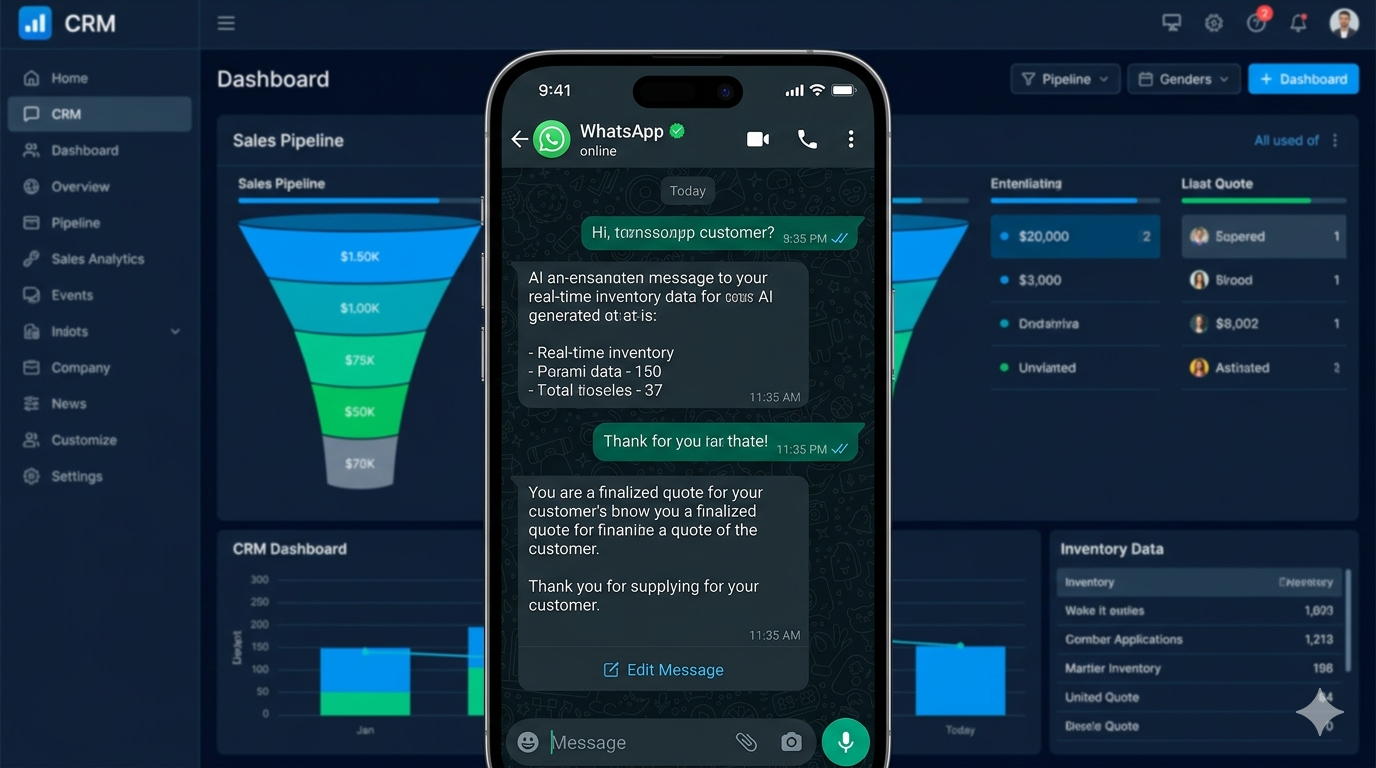
Now imagine they write to a WhatsApp number: "How many units do we have of product X in the Monterrey warehouse?" And in 3 seconds they get: "142 units available. List price: $385 + tax. Should I generate a quote?"
That's a conversational CRM. It's not a CRM with a chat slapped on — it's a system where conversation is the primary interface.
Why traditional CRM doesn't work in the field
Traditional CRMs are designed to be used sitting in front of a computer. They have hierarchical menus, complex filters, forms with 20 fields, and dashboards that require a large monitor to understand. They're desktop tools.
But real sales don't happen at a desk. They happen on the street, in the client's warehouse, on a phone call, in the parking lot between one visit and the next. The salesperson who needs information needs it now, not when they get back to the office.
And what happens in practice is predictable: the salesperson doesn't use the CRM in the field. They jot things in a notebook, send a WhatsApp to the warehouse asking about stock, call the office for a price, make the quote from memory and formalize it later. The CRM gets filled at the end of the day — when they remember — with incomplete or incorrect data.
The problem isn't the salesperson. It's that the tool doesn't adapt to how they work.
WhatsApp as a business interface
In Mexico, WhatsApp isn't a messaging app — it's the communication infrastructure for businesses. 95% of commercial communication between SMEs happens through WhatsApp. Quotes, orders, confirmations, complaints, collections — all through WhatsApp.
If your entire commercial operation already runs through WhatsApp, doesn't it make more sense for your CRM to live there too?
A conversational CRM puts an AI agent on the other end of a WhatsApp number (or Telegram). That agent has access to the product catalog with prices and stock, the client directory, purchase history, overdue receivables, and the ability to create records in the system.
The salesperson doesn't need to learn a new system. They already know how to use WhatsApp. The learning curve is zero.
Three agents, three specialties
A single agent that does everything is an agent that does everything poorly. The complexity of handling sales, collections, and inventory in a single context creates confusion and errors.
The right architecture is having specialized agents, each an expert in its domain:
Sales Agent. Knows the complete catalog with updated prices and real-time stock. Searches clients by name or tax ID. Generates formal quotes with products, quantities, prices, and discounts. Manages the opportunity pipeline (prospects, in negotiation, closed). Automatically follows up on unanswered quotes. Detects clients who haven't purchased in over 30 days.
Example conversation: "Give me a quote for Distribuidora López: 50 boxes of product ABC and 30 of product DEF" → The agent queries prices and stock, verifies availability, applies the configured discount for Distribuidora López, and generates the quote with totals and tax.
Collections Agent. Knows each client's account balance to the cent. Generates aging reports (30, 60, 90, 120+ days). Records payments against specific invoices. Sends reminders to clients with overdue invoices. Calculates total overdue receivables by branch, by salesperson, or overall.
Example conversation: "How much does client Comercial Hernández owe us?" → The agent queries outstanding invoices, sums the amounts, groups by age, and responds with the complete breakdown.
Purchasing Agent. Controls real-time inventory by warehouse. Detects products below reorder point and suggests quantity and supplier based on history. Creates purchase orders. Records merchandise receipt with lot control and expiration dates. Detects duplicate purchase invoices before entry.
Example conversation: "What products are below minimum in the Guadalajara warehouse?" → The agent queries inventory, filters those below reorder point, and lists each product with current stock, configured minimum, and suggested supplier.
Real data, not hallucinations
This is the critical point that differentiates an enterprise agent from a generic chatbot.
When the Sales Agent says there are 142 units of product X, that number comes from a direct query to the inventory database. It's not an estimate, not a historical average, not a number that "sounds reasonable." It's the real data, in real time.
When the Collections Agent says Distribuidora López owes $347,520, that number is the sum of outstanding invoices recorded in the system. It's not an approximation. It's the exact amount.
This difference seems obvious, but most "AI for business" solutions sold today are chatbots built on a generic language model that has no access to real data. Ask it about stock and it invents a plausible number. Ask about overdue receivables and it gives you a figure that sounds right but has no relation to reality.
In a business context, incorrect data is worse than no data. A quote with a wrong price can cost you the margin on a deal. A collection with an incorrect amount creates friction with the client. A supplier order based on false stock creates overstock or shortages.
Mexican billing integrated
A conversational CRM for the Mexican market must understand the country's fiscal reality. That means validating tax IDs before invoicing, knowing tax regimes, handling fiscal postal codes, and generating the information needed to stamp CFDI.
The agent doesn't stamp directly — that's the PAC's job. But it validates that the client's tax data is correct before generating the invoice, avoiding data entry errors that cause cancellations and re-stamps.
It also understands credit notes, payment supplements, and the relationship between invoices and partial payments. Collections in Mexico have complexities that a generic system doesn't handle.
Who this is for
The conversational CRM isn't for every company. It's specifically for organizations where commercial operations are dynamic and the field team needs real-time information:
Trading companies. Companies that buy and resell products with variable catalogs, margins that depend on volume, and street salespeople who need to check prices and stock on the spot.
Distributors. Companies with multiple warehouses that need cross-warehouse stock visibility and replenishment control without depending on a complex ERP.
Growing businesses. Businesses that currently operate with Excel for inventory, WhatsApp for sales, and a notebook for collections, and need to professionalize without the learning curve of SAP or Oracle.
If your sales team already lives on WhatsApp, the CRM should live there too.
The Manager: your operation in a conversation
At Leeuwwolk we developed The Manager with this philosophy: AI isn't a CRM feature — it's the primary interface. The three agents (Sales, Collections, Purchasing) operate with real system data, execute concrete actions, and are available 24/7 via WhatsApp, Telegram, or web dashboard.
It runs on open-source language models. Leeuwwolk guarantees the privacy of your commercial data: encryption in transit and at rest, without sharing information with third parties or sending it to public AI services.
→ Learn about The Manager and manage your business by talking
Leeuwwolk is a Mexican company specializing in private artificial intelligence and conversational business management.