ICD-11 in Electronic Health Records: What It Is and How to Implement It
The International Classification of Diseases in its eleventh revision (ICD-11) is the World Health Organization's new standard for coding diagnoses, causes of death, and health conditions. It replaces ICD-10, which had been in use since 1990.
What changes with ICD-11
ICD-11 is not simply a code update. It's a redesign of the classification structure.
Greater granularity: ICD-11 allows coding conditions with more detail. Instead of a single code for "type 2 diabetes mellitus," you can specify the type, associated complications, laterality, and severity, all in a single compound code.
Extension coding: extension codes allow adding clinical information without creating new codes. You can indicate whether a condition is acute or chronic, whether it's a primary or secondary diagnosis, and its relationship with other conditions.
Digital-native structure: unlike ICD-10 (designed for paper), ICD-11 was conceived for electronic systems. Its structure is compatible with databases, APIs, and clinical decision systems.
Traditional medicine: for the first time, it includes a chapter dedicated to traditional medicine, relevant for the Mexican context.
Impact on your health record
If your electronic health record system uses ICD-10, you need to plan the migration. It's not urgent today — the transition is progressive — but the longer you wait, the more complex the change will be.
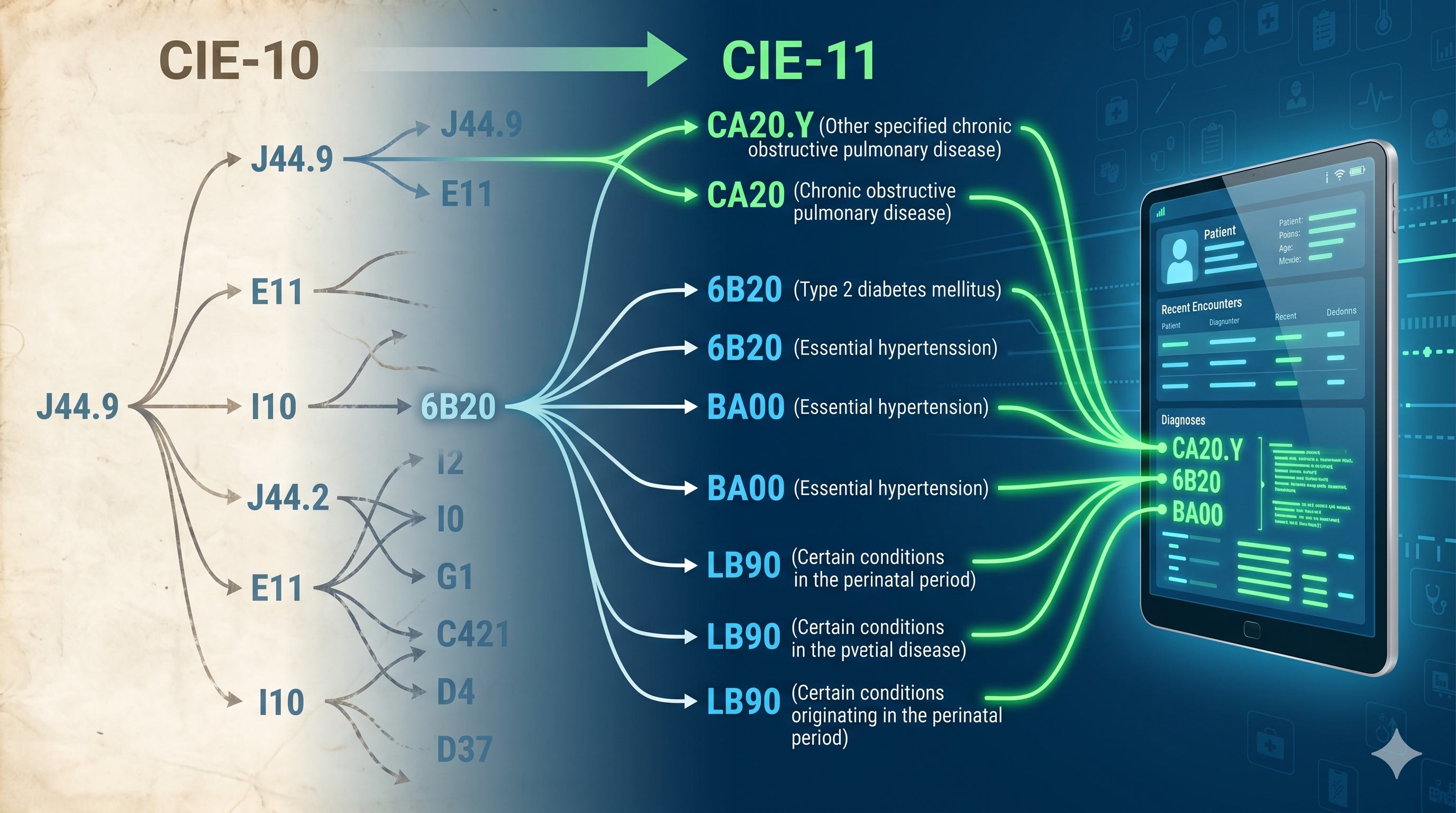
What your system needs is an updated and searchable ICD-11 catalog, extension coding capability, mapping of existing ICD-10 codes to ICD-11 for previous histories, and intelligent search that allows the physician to find the correct code without memorizing the complete classification.
The role of AI
This is where artificial intelligence adds real value. A system with AI can suggest ICD-11 codes from the free-text description the physician dictates or writes. The physician describes "patient with type 2 diabetes with incipient nephropathy" and the system suggests the corresponding ICD-11 code with appropriate extensions.
This reduces coding time and improves accuracy — the physician doesn't need to manually search through a catalog of thousands of codes.
Medicus integrates ICD-11 with AI-assisted code suggestions. Data is processed locally — patient information never leaves your server.