How to Automate Legal Document Analysis with AI (Without Sending Your Documents to the Cloud)
A compliance analyst receives a package of 47 documents for onboarding a new client: articles of incorporation, powers of attorney, shareholder IDs, proof of address, financial statements, beneficial ownership records. They must extract key data from each one, cross-reference information between them, detect inconsistencies, and generate a report.
With luck, it takes a day. With bad luck (scanned documents, inconsistent formats, mixed languages), it takes two or three. And if there are 10 packages in the queue, the bottleneck turns into weeks of delay.
But document analysis is not limited to compliance. A notary receiving a file for a property sale needs to verify prior deeds, valid powers of attorney, identifications, and lien certificates. A litigation attorney preparing a case reviews hundreds of contracts, corporate minutes, and communications looking for relevant clauses and contradictions. A corporate law firm advising on a merger processes the complete documentation of both entities. An auditor reviewing a company's compliance needs to cross-reference dozens of contracts against their deliverables and payments.
In every case, the pattern is the same: someone reads documents one by one, manually extracts data, and cross-references information in spreadsheets. It is tedious, error-prone, and does not scale.
This article explains how artificial intelligence can reduce this process from hours to minutes, why traditional template-based OCR is no longer sufficient, and why it matters that your documents never end up in a public AI service.
The problem with manual document analysis
Legal and corporate document analysis is a task that combines the worst of both worlds: it requires attention to detail (a mistyped tax ID, an incorrect ownership percentage, a wrong date, an expired power of attorney that was overlooked) and is enormously repetitive (the same type of extraction, document after document, week after week).
The professionals who suffer most from this are notaries assembling deed files, compliance and KYC teams at financial institutions, law firms handling due diligence or document-heavy litigation, audit and internal control departments, and any legal professional who processes documents as part of their daily operations.
The cost is not just the professional's time. It is the cost of the error that went undetected: the beneficial owner who exceeded the regulatory threshold and was not identified, the contract with a clause that contradicts another document in the package, the expired ID that was accepted because nobody checked the date, the power of attorney that was no longer valid when the act was signed.
Why traditional OCR falls short
The first generation of document automation solutions used OCR (Optical Character Recognition) with fixed templates. The idea was: if you know that the tax ID always appears in the upper right corner of the tax compliance certificate, you program a rule to read that zone of the document.
This works reasonably well when all documents have exactly the same format. But in the reality of legal documents, formats vary enormously. Articles of incorporation from 1998 look nothing like those from 2024. A power of attorney from one state has a different structure than one from another. A property deed varies between notaries, states, and time periods.
Template-based OCR breaks every time the format varies. And with legal documents, the format always varies.
Contextual AI: understanding the document, not just reading it
The alternative is to use language models that understand the content of the document — they don't just read it character by character, but comprehend what type of document it is, what information it contains, and where to find it.
When a language model analyzes articles of incorporation, it doesn't look for text at fixed page coordinates. It understands that it is reading articles of incorporation, identifies the section where shareholders are declared, extracts the names and ownership percentages, and returns them as structured data.
If the document has a different format — different notary, different state, different year — the model still works because it understands context, not page geometry.
The same applies to any type of legal document: the model understands it is reading a power of attorney and extracts the grantor, the attorney-in-fact, the powers granted, and the validity period. It understands it is reading a sale deed and extracts the parties, the property, the price, and the conditions. It does not need a template for each format variation because it comprehends content, not layout.
This is a qualitative shift. It is not more accurate OCR — it is a fundamentally different way of processing documents.
The processing workflow
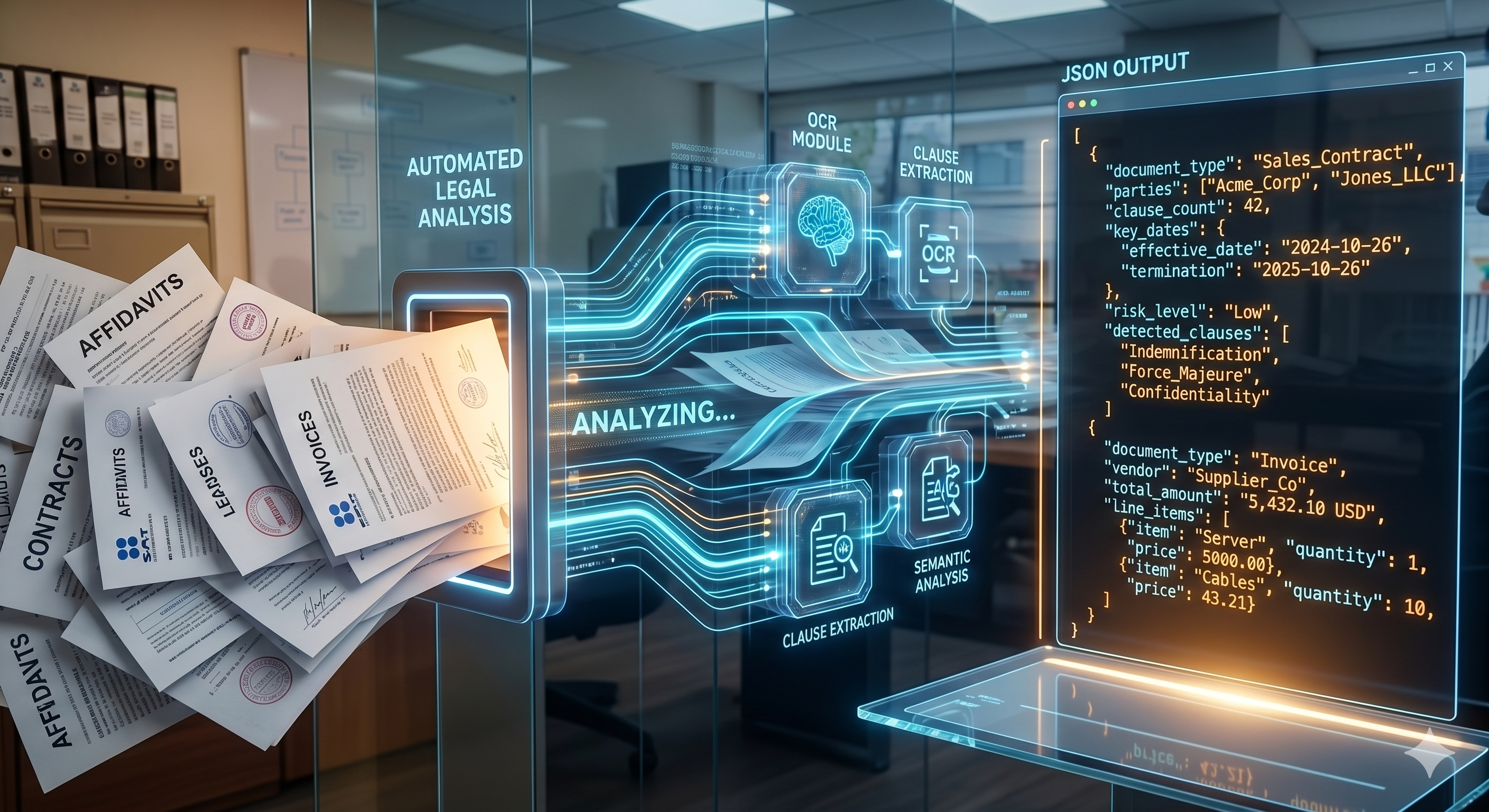
A modern AI document analysis system follows these steps:
Automatic classification. The system receives a package of documents and classifies each one by type: articles of incorporation, personal ID, proof of address, power of attorney, public deed, contract, judicial resolution. You don't need to pre-classify or name the files in any specific way.
Intelligent OCR. Scanned documents pass through a specialized OCR model that extracts text page by page. Native PDFs (generated digitally, from Word for example) are processed directly without quality loss. The OCR model is trained to handle documents with stamps, signatures, watermarks, and low resolution — normal conditions in Mexican legal documentation.
AI extraction. Each document is analyzed with a language model and a specialized prompt for that document type. The model extracts structured data: company name, tax ID, date of incorporation, registered address, shareholder names, ownership percentages, corporate purpose, power of attorney scope and validity, contract parties, key clauses.
Cross-validation. Data extracted from different documents is automatically cross-referenced. If the articles of incorporation state that Juan Pérez holds 30% and the ID says "Juan Manuel Pérez García," the system uses fuzzy name matching to link them and detect that they are probably the same person. If a shareholder exceeds the beneficial ownership regulatory threshold (25% in most jurisdictions), they are automatically flagged.
Structured results. Extracted data is presented in a consolidated view where the professional can review, correct if necessary, and approve. Review time is a fraction of manual extraction time.
Why your documents should never reach a public AI chat
Here is a point that many solutions ignore. The documents processed by a notary, a law firm, or a compliance team are, by definition, sensitive: personal IDs, tax data, financial information, corporate ownership structures, confidential contracts, privileged client information.
If the document analysis system sends these files to a cloud API (OpenAI, Google Cloud, AWS) for processing, that data is traveling over the internet and being processed on servers you do not control. For a notary, this may compromise professional secrecy. For a regulated financial institution, it may violate data protection regulations and anti-money laundering rules. For a law firm, it may breach attorney-client privilege.
The alternative is working with a provider that guarantees privacy. At Leeuwwolk, documents processed through Fulcro are protected with encryption in transit and at rest. We do not use your information to train models, we do not share it with third parties, and it never reaches public AI services like ChatGPT, Gemini, or Copilot. Your information is processed, results are delivered to you, and that's it. No fine print.
This is not just a security preference — for certain regulated sectors and professions bound by professional secrecy, it is a requirement.
What types of documents can be processed
The most common documents in legal and corporate analysis include:
Articles of incorporation. Company name, entity type, corporate purpose, date of incorporation, registered address, notary data, shareholders with percentages.
Powers of attorney. Grantor, attorney-in-fact, type of power (general, special, for litigation and collections), specific faculties, validity, limitations.
Public deeds. Parties, subject of the act, property or asset description, price, conditions, liens, notary and public registry data.
Tax IDs. RFC (Mexico), EIN (USA), Tax ID (other countries). Extraction with format validation and check digit when applicable.
Personal IDs. National ID cards, passports, driver's licenses. Full name, date of birth, expiration date, document number.
Proof of address. Structured address: street, number, neighborhood, postal code, city, state, country.
Shareholder records. Beneficial owners, ownership percentages, control chain, nationality.
Contracts. Parties involved, subject matter, term, amount, key clauses, termination conditions, penalties, jurisdiction.
Judicial and administrative resolutions. Parties, issuing authority, ruling, operative paragraphs, dates.
Corporate minutes. Resolutions adopted, quorum, voting results, appointments, bylaw amendments.
This list is illustrative, not exhaustive. Fulcro processes any legal or corporate document containing structured information that needs to be extracted. The language model understands document context — it does not depend on a closed list of types. If tomorrow you need to process expert reports, no-lien certificates, or compliance attestations, the system understands them without additional configuration.
Fullkro: document analysis with private AI
At Leeuwwolk we developed Fullkro, a document analysis platform that uses OCR and AI models to extract structured data from any legal and corporate document. We guarantee your information's privacy: data encrypted in transit and at rest, never shared with third parties, never used to train models, and never sent to public AI services.
The OCR model was trained on over 950 real Mexican legal documents to maximize accuracy in the specific context of legal documentation in Mexico. AI extraction achieves 94% coverage on key fields, compared to 63% from generic cloud AI services.
For notaries, law firms, financial institutions, auditors, or any professional who processes legal documents as part of their daily operations.
→ Learn about Fullkro and automate your document analysis
*Leeuwwolk is a Mexican company specializing in private artificial intelligence for the legal sector. We guarantee your information's privacy: encryption in transit and at rest, no data shared with third parties, no data used for model training.