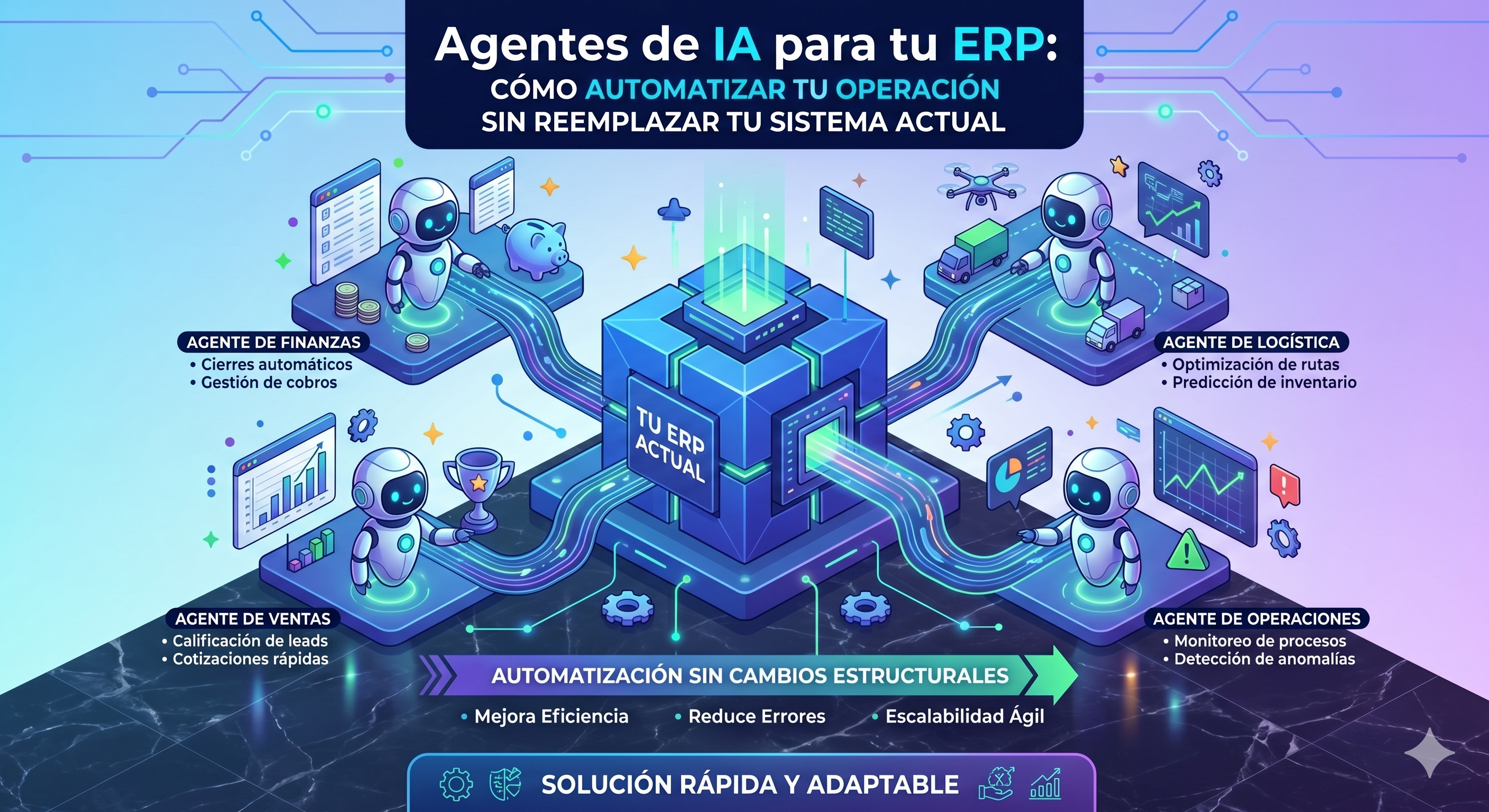
AI Agents for Your ERP: How to Automate Operations Without Replacing Your Current System
The typical conversation about AI in a mid-size company starts with enthusiasm and ends with a number: the migration cost. "How much does it cost to switch our current system to one with AI?" The answer is usually enough to kill any project before it starts.
But there's a flawed premise in that question. You don't need to replace your system. You need an intelligence layer that talks to your current system — that queries it, operates it, and makes it accessible in ways that aren't possible today.
That layer is an AI agent.
The "you need to migrate" fallacy
Software companies have been selling the same idea for decades: "your current system is outdated, you need ours." It's a legitimate business model but enormously costly for the client.
An ERP migration means months of implementation, staff retraining, risk of data loss, and the certainty that operations will degrade during the transition. Migrations from SAP to Oracle, Oracle to Dynamics, Dynamics to whatever, are projects that cost millions and take years.
The alternative that AI enables today is radically different: instead of replacing the system, you put an intelligent agent in front that knows how to talk to it.
What is an agent connected to your backend
An AI agent connected to your backend has two fundamental capabilities: it understands natural language (what you tell it) and knows how to execute operations in your system (what your database or API allows).
When you write "how many units of product XYZ do we have in the warehouse?", the agent translates that into a SQL query or API call against your real system, gets the result, and presents it in natural language. It doesn't guess. It doesn't estimate. It queries.
When you write "create a quote for client López for 100 units of product ABC at list price," the agent checks the current price in your catalog, verifies available stock, applies whatever discount rules you have configured, and generates the quote in your system. Not in a parallel system — in yours.
"But my system is too old/weird/custom"
This is the most common objection, and curiously, it's where agents shine the most.
If your system has a relational database (PostgreSQL, MySQL, SQL Server, Oracle), an agent can query it directly with SQL. It doesn't matter if the database has 50 or 500 tables, if it was designed in 1998 or 2024. SQL is SQL.
If your system exposes a REST API, the agent can consume it. If your system doesn't have an API but has a web interface, an intermediate layer can be built to expose the necessary operations. It's not ideal, but it's much cheaper than a migration.
The point is: an AI agent doesn't need your system to be modern, elegant, or well-documented. It needs access to data and operations. The agent provides intelligence and the conversational interface — your system provides the data and business rules you already have implemented.
What an agent connected to your ERP can do
Real-time queries. Stock by product and warehouse, account status by client, aging receivables, purchase history, updated prices. Any data in your database is accessible via natural conversation.
Record creation. Quotes, purchase orders, invoices, credit notes, payment records. The agent creates records in your system with the correct data, applying existing validations.
Proactive alerts. Products below reorder point, clients with invoices overdue by more than 90 days, purchase orders pending receipt. The agent can notify via WhatsApp when it detects conditions requiring attention.
On-demand reports. "Give me last month's sales grouped by salesperson" shouldn't require opening the ERP, navigating 5 menus, configuring filters, and exporting to Excel. It should be a question with an answer.
What it CANNOT do (and shouldn't try)
An agent connected to your ERP doesn't replace the system's complete interface. Complex operations — configuring a new price list with 500 products, restructuring the chart of accounts, migrating historical data — require the ERP's native interface.
The agent covers 80% of daily operations your team needs: query, create, modify, report. The other 20% — administration, configuration, bulk operations — continues in the system directly.
It also shouldn't make autonomous decisions involving financial or legal risk without human approval. A well-designed agent proposes and waits for approval on sensitive operations: "Client López has $50,000 in available credit, shall I generate the invoice?" The human approves, the agent executes.
Open language models vs commercial APIs
For enterprise agents, open-source models have a decisive advantage: your company's data is never sent to public AI services like ChatGPT or Gemini.
When an agent processes the query "how much does López Distribution owe us?", the language model sees the client name, the owed amount, the overdue terms. If that model runs on an OpenAI server, that data travels over the internet. With Leeuwwolk, your data is protected with encryption in transit and at rest, never shared with third parties.
The Manager: agents ready to operate
At Leeuwwolk we developed The Manager with exactly this problem in mind. It's a business management system with three specialized agents (Sales, Collections, Purchasing) that operate via WhatsApp, Telegram, or web dashboard.
Today, The Manager includes its own CRM, ERP, and inventory with real data that the agents query and operate. The tool architecture is designed to be extensible — each tool is a function that connects the agent with a backend operation, allowing future connection of similar agents against clients' existing systems.
The vision is that if your operation already runs on PostgreSQL, MySQL, or any relational database, a Leeuwwolk agent can talk to it without you migrating anything.
→ Learn about The Manager and its AI agents
Leeuwwolk is a Mexican company specializing in private AI and enterprise agents. We guarantee your data's privacy: encryption in transit and at rest, no sharing with third parties or sending to public AI services.