Why AI Agents Need Real Data and Must Not Hallucinate
You ask an AI chatbot how many units you have in stock and it says "approximately 200." The number sounds reasonable. You use it to respond to the client. When you go to the warehouse, there are 47. You just looked bad in front of a client and possibly committed to a delivery you can't fulfill.
This is called hallucination: when a language model generates information that sounds plausible but has no relation to reality. In casual conversations it's anecdotal. In a business context it's dangerous.
What a hallucination is and why it happens
Language models (GPT, Llama, Qwen, Gemini) work by predicting the next most probable word given a text sequence. They are extremely good at this — so good they can generate responses that sound perfectly coherent, informed, and reliable.
The problem is that "sounding reliable" and "being correct" are completely different things.
When you ask a generic language model "how many units of product X do we have?", the model has no access to your inventory. But it's trained to give useful responses, so it generates a number that fits the conversation context. It doesn't lie intentionally — it simply doesn't know the answer and generates what's most probable.
This is acceptable when you ask it to write a poem or summarize a public article. It is unacceptable when you ask for your business data.
The real cost of a business hallucination
In a business context, incorrect data has measurable consequences:
Quote with wrong price. The agent says the product costs $380 when it actually costs $420. The client accepts the quote. Now you have a commitment at a price that eats your margin or you have to go back and renegotiate.
Phantom stock. The agent says there are 200 units available. You commit to delivery. In the warehouse there are 47. The client doesn't receive on time and penalizes you or switches suppliers.
Miscalculated receivables. The agent says a client owes you $150,000 when they actually owe $280,000. The difference is $130,000 you're not collecting on time.
Duplicate purchase order. The agent doesn't detect that there's already an open purchase order with the same supplier for the same product. You buy double. Overstock. Pay double freight.
Each of these scenarios is a chatbot that sounded very smart generating data it didn't verify against reality.
How it's solved: tools + real data
The solution is not "better train the model" — it's giving it access to real data. An enterprise AI agent differs from a generic chatbot because it has tools: functions that allow it to query and operate on real systems.
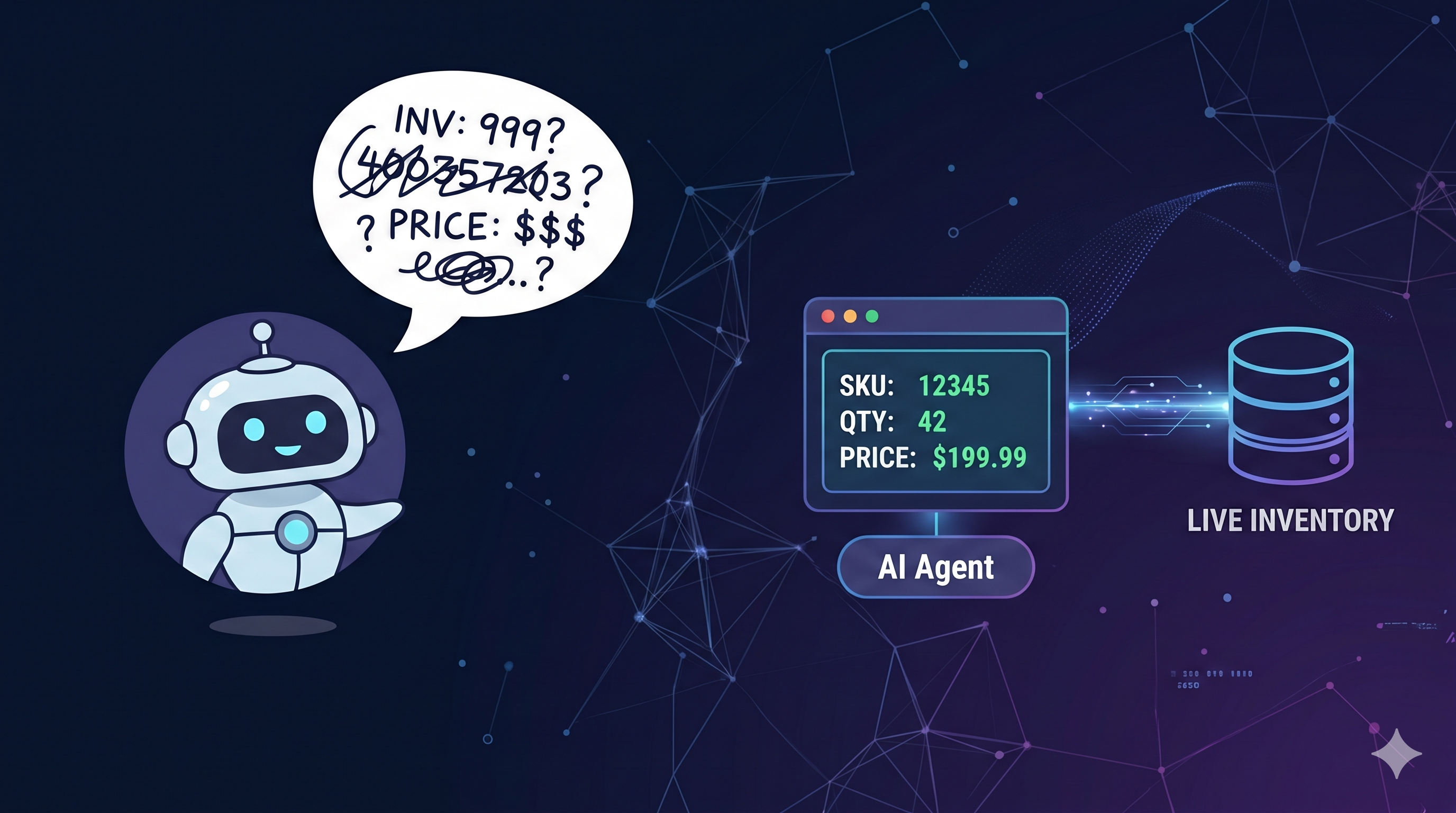
When the Sales Agent receives "how many units of product X do we have?", it doesn't generate a number. It invokes a tool: query_inventory(product="X", warehouse="all"). That tool executes a SQL query against the real inventory table and returns the exact data point. The agent presents that data to the user.
There is no room for hallucination because the response is not generated by the language model — it's generated by the database. The model only decides which tool to use and how to present the result.
The same applies to prices (query the real catalog), overdue receivables (query real invoices), client data (query the real CRM). Every critical data point comes from a verifiable source, not from the model's imagination.
The pattern: reason + act
The architecture that solves business hallucinations is known as ReAct (Reasoning + Acting). The language model does two things:
Reasons about what the user needs. "The user wants to know the stock of product X. I need to query inventory."
Acts by invoking the correct tool. It executes query_inventory and gets the real data.
If the tool returns that there's no stock, the agent says there's no stock — it doesn't invent a number to look good. If the client doesn't exist in the system, it says it wasn't found — it doesn't fabricate fictitious data.
This pattern applies to every interaction. The agent never responds with data that doesn't come from a verifiable source. It can reason, suggest, prioritize — but the data is always real.
Additional validations
Beyond querying real data, a well-designed agent implements validations that prevent errors:
Stock verification before quoting. It won't generate a quote if there isn't enough inventory to fulfill the order.
Tax data validation. It verifies the tax ID format and tax regime coherence before creating an invoice.
Duplicate detection. Before recording a purchase order or payment, it verifies no similar recent record exists.
Authorization limits. Operations exceeding a certain amount require human approval. The agent proposes but doesn't execute unilaterally.
These validations don't depend on the language model — they are business rules implemented in the tools. The model cannot bypass them.
The Manager: real data, always
At Leeuwwolk we developed The Manager with a simple rule: every data point an agent presents to the user comes from a real system query. The three agents (Sales, Collections, Purchasing) operate exclusively with tools that query the database in real time.
There are no estimates, no approximations, no model-generated data. If the agent says there are 142 units, there are 142 units. If it says the client owes $347,520, that is the exact sum of their outstanding invoices.
→ Learn about The Manager: agents that don't hallucinate
Leeuwwolk is a Mexican company specializing in enterprise AI agents that operate with real data.